


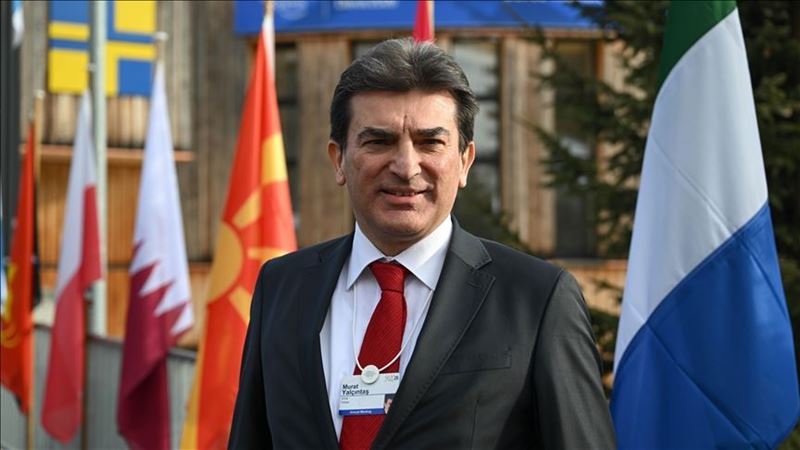
Murat Yalçıntaş stated that OYAK positions 2026 as a “consolidation year,” during which operational resilience will be strengthened and the foundation for achieving its 2030 targets will be solidified. He emphasized that the institution aims to reach USD 60 billion in assets by 2030.
Operating across mining and metallurgy, cement-concrete-paper, automotive, energy, chemical, food, finance, and construction sectors, OYAK will pursue a disciplined growth and high-efficiency strategy to navigate global economic uncertainties. The institution has set targets of USD 60 billion in assets, USD 10 billion in export volume, and a total workforce of 39,000 employees by 2030.
Yalçıntaş highlighted that OYAK’s future projections are built on selective growth, strong cash generation, and strategic portfolio transformation. He noted that 2026 will serve as a threshold year, focusing more on cash generation and operational resilience rather than rapid growth.
The portfolio architecture is centered around infrastructure, energy, high technology, logistics, and mining. Infrastructure investments are designed to form the backbone of the portfolio in terms of predictable cash flow and balance sheet resilience. Energy investments play a critical role in ensuring continuity and efficiency of industrial operations. Artificial intelligence and IT sectors offer leverage for scalability and competitive advantage, while logistics and mining investments complement global supply chain security and resource access. In the automotive sector, OYAK plans to invest in hybrid engine and electric vehicle technologies.
Yalçıntaş also emphasized OYAK’s contribution to the Turkish economy. The group’s companies hold a critical position through production capacity, export performance, and employment contributions. OYAK alone accounts for 1.7% of total taxes paid in Türkiye and 2.3% of total exports. The group is a leader in steel and crude steel production, ranks first in Türkiye’s automotive exports, and plays a strategic role in energy supply security and infrastructure continuity. In the chemical and agriculture-food sectors, OYAK maintains an export- and value-added-focused production structure.
Regarding global operations, Yalçıntaş noted that OYAK operates in 24 countries across 6 continents, exporting to more than 115 countries. In line with the 2030 vision, the group is pursuing controlled and disciplined growth focused on deepening presence in existing markets rather than geographic expansion. The export strategy emphasizes value-added products, product mix diversification, and sustainable market share, rather than merely increasing the number of markets. Through this approach, OYAK aims to reach $10 billion in exports by 2030, with total employment increasing to 39,000 employees.
As part of the 2030 vision, OYAK is also evaluating public offerings for some subsidiaries that have reached maturity and demonstrate sustainable growth potential. Yalçıntaş stressed that these Initial Public Offerings are not only financing tools but also strategic instruments that strengthen the capital structure, deepen corporate governance standards, and make the value created within the portfolio visible. Through Initial Public Offerings in Türkiye and abroad, OYAK aims to increase the portfolio’s presence in capital markets by at least 50%.



Comments
No comment yet.