


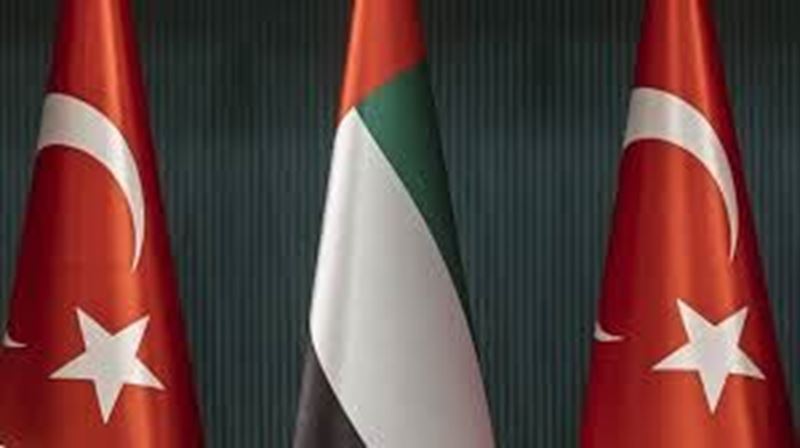
Turkish business leaders expect President Recep Tayyip Erdoğan’s upcoming visit to the United Arab Emirates (UAE) to move the bilateral cooperation agenda toward a more concrete and implementation-oriented framework in areas such as trade, investment, technology, energy, and logistics.
President Erdoğan is scheduled to visit the UAE on February 16. In addition to diplomatic contacts, intensive commercial and economic meetings are expected to take place. A large delegation of ministers and business representatives is also planned to accompany the President.
UAE President Mohammed bin Zayed Al Nahyan visited Türkiye in July 2025, during which the first meeting of the High-Level Strategic Council between the two countries was held. Seven agreements were signed as part of that visit.
Trade volume reaches USD 19 billion
The increase in bilateral trade volume between the two countries, which have maintained intensive diplomatic and economic engagement, has also drawn attention. In 2024, Türkiye’s exports to the UAE amounted to USD 8.3 billion, while imports from the UAE stood at USD 7.4 billion, bringing the total foreign trade volume to USD 15.7 billion.
In 2025, Türkiye’s exports to the UAE increased to USD 9.3 billion, while imports reached USD 9.7 billion, pushing the total trade volume to USD 19 billion.
Last year, the top export category from Türkiye to the UAE was “precious or semi-precious stones, precious metals, pearls, imitation jewelry, and coins,” amounting to USD 4.9 billion.
“Exports should achieve a more balanced structure”
Foreign Economic Relations Board of Turkey (DEİK) Türkiye-UAE Business Council Chairman Mehmet Ali Akarca stated that economic relations between the two countries have evolved into a stable, institutionalized, and multidimensional structure.
Highlighting the growth in bilateral trade volume, Akarca said, “These figures clearly demonstrate that the UAE is one of Türkiye’s most important trade partners. We consider this picture as the result of a long-term process shaped by a ‘commercial diplomacy’ approach. Increasing high-level contacts, regular business council activities, and private sector engagement in recent years have strengthened economic ties not only quantitatively but also qualitatively.”
Akarca noted that the jewelry sector ranks first in Türkiye’s exports to the UAE, while machinery and equipment, construction materials, food products, automotive, chemicals, and defense industries remain traditionally strong sectors. He explained that these industries benefit from the UAE’s high-income consumption structure and large-scale project economy, which create stable demand.
He added that Turkish companies have recently increased their visibility in digital technologies, software, artificial intelligence, cybersecurity, and financial technologies. “Jewelry, machinery and equipment, construction materials, and food products maintain a competitive advantage thanks to strong demand. In addition, high value-added fields such as digital technologies, software, and cybersecurity provide Türkiye with a competitive edge due to its production flexibility and engineering capabilities.''
Regarding the bilateral trade target, Akarca stated: “Considering the Comprehensive Economic Partnership Agreement in force and the current positive momentum, we expect Türkiye-UAE foreign trade to maintain a stable course this year as well. The stated goal between the two countries is to reach a trade volume of 40 billion dollars. Our main priority in this process is not only to increase the total volume but also to ensure that exports gain a more balanced, diversified, and high value-added structure. Increasing the share of technology and services exports will be a key indicator of this transformation.”
“Türkiye-UAE relations are a strategic economic partnership”
Akarca emphasized that President Erdoğan’s visit represents a significant milestone in deepening bilateral economic relations. He stated that they expect the cooperation agenda to be translated into a more concrete and implementation-focused framework, particularly in trade, investment, technology, energy, and logistics.
Noting that high-level visits should translate into tangible opportunities for the business community, Akarca concluded:
“We expect these engagements to revolve around meetings that enhance business interaction, joint investment and project development areas, and regulatory arrangements that facilitate private sector activity. Today, Türkiye-UAE relations should not be viewed merely as a foreign trade relationship but as a strategic economic partnership. In the upcoming period, our goal is to ensure that Turkish companies become more firmly established in the UAE market, that joint investments increase, and that the two countries strengthen their presence together in third markets. As the Business Council, we will continue to transform this strong foundation into concrete cooperation.”




Comments
No comment yet.