


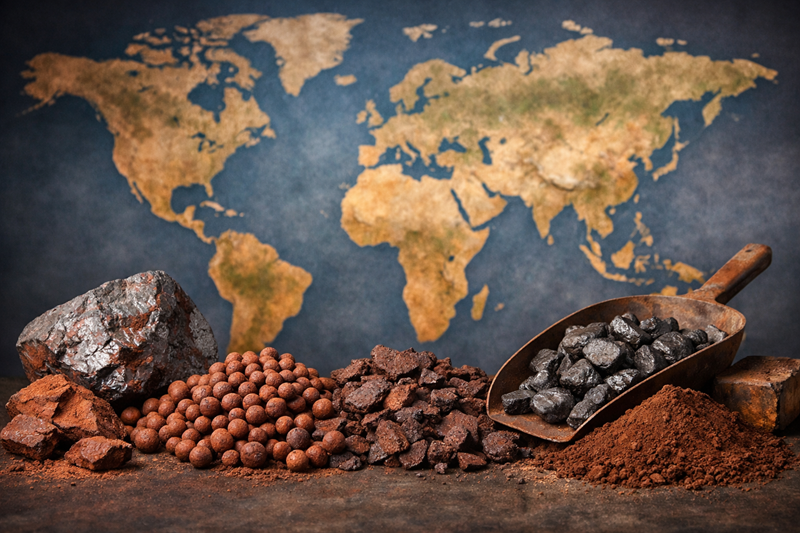
Emerging iron ore sites and capacity expansions have the potential to impact the global supply–demand balance in the coming years. Regions with high reserves that are not yet fully developed are coming back into focus as investment decisions accelerate and the Simandou project successfully comes online. In particular, Africa has recently become the center of international attention due to iron ore projects.
Rhodes Ridge (Pilbara, Western Australia) -Long-Term Production Potential
Described as “one of the world’s best undeveloped iron ore deposits,” Rhodes Ridge is being developed through a partnership between Rio Tinto, Mitsui & Co., and AMB Holdings. Ongoing feasibility studies target an initial production of approximately 40 million tons per year, with total potential capacity expected to reach 100 million tons per year. A budget of USD 294 million has been allocated for this phase, with an additional USD 225 million planned for further exploration and technical work through 2028. Feasibility is expected to be completed by 2029, with first ore production projected to begin in 2030.
Despite the already high production levels in Pilbara, the presence of large-scale undeveloped reserves positions Rhodes Ridge as a key component in the region’s long-term production plans. Major investment requirements and permitting processes remain key risks.
Hamersley Region (Australia) — Resource Potential and Investment Momentum
Recent geological studies and analyses in the Hamersley region of Pilbara indicate very large-scale iron ore potential. These studies suggest that the total potential resources in the region could be in the tens of billions of tons, with an average iron content exceeding 60%. This scale is theoretically estimated to correspond to an economic value in the trillions of dollars at current prices. Experts note that such high-grade resources could contribute to global supply security and price stability in the long term.
Additionally, capacity and operational investments at the Paraburdoo site under the collaboration between Rio Tinto and China’s Baowu Steel Group are coming to the fore. Rio Tinto’s multi-year investment program in Pilbara continues to support Australia’s strong position in iron ore exports.
Zogota (Guinea–Liberia Border) — Development Process and Corridor Uncertainty
Located north of Simandou, the Zogota site has historically attracted attention from various companies but remained largely undeveloped. The project is now being redeveloped by the UK-based private investment firm Niron Metals. However, there is no confirmation of commercial production to date.
Guinea’s prioritization of its own Trans-Guinean railway and the lack of official approval for cross-border transportation leave export options via Liberia uncertain. This is considered an indirect factor that could affect Zogota’s export planning and investment timeline.
Tonkolili (Sierra Leone) — Local Processing Investments
With an estimated reserve potential of around 10 billion tons, Tonkolili is one of Africa’s largest iron ore sites. The Phase I magnetite beneficiation plant, implemented by Leone Rock Metal Group, commenced operations on April 15, 2025, with a processing capacity of 10 million tons of raw ore per year. Once operating at full capacity, the plant aims to produce approximately 10 million tons of concentrate with 66% Fe content from 30 million tons of raw ore annually. The project aligns with Sierra Leone’s goals to increase mining value addition, providing employment growth and local development funding.
Medium-Term Outlook for Iron Ore Mines
Capacity expansions in Pilbara and Carajás could support the supply of high-quality iron ore in the coming years. Meanwhile, Guinea’s national infrastructure-based strategy may reduce the importance of regional transit models. Competition in the iron ore market will continue to be shaped not only by production volume but also by access to infrastructure, permitting processes, and operational sustainability.



Comments
No comment yet.