


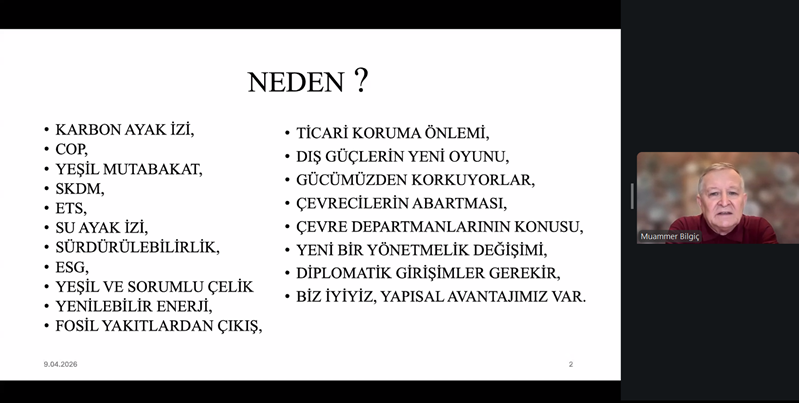
Bilgiç began his speech by emphasizing that the Carbon Border Adjustment Mechanism (CBAM) is no longer a theoretical uncertainty, but has become a commercial reality with direct financial implications as of 2026. He stated that this process is not merely a bureaucratic regulation, but represents a global transformation marking the transition away from an industrial system based on fossil fuels for nearly 300 years.
Noting that the Turkish industry had long perceived this process as an “external pressure” or a “postponable obstacle,” Bilgiç said it has now become an unavoidable ecological and economic necessity. He highlighted that atmospheric carbon dioxide levels are only 3–4 years away from reaching the critical threshold of 450 ppm, stressing that the climate crisis has become a measurable and serious risk.
In his assessment of the steel sector, Bilgiç pointed out that the European Union’s declared default emission values are intentionally set high to encourage producers to verify their own data. However, he emphasized that the main risk lies in the benchmark values based on the average performance of the top 10% of EU producers. He noted that these benchmarks are significantly lower than current production levels in Turkey, which could create serious competitive pressure.
Bilgiç also warned that CBAM-related costs could increase by four to five times once emissions from electricity consumption (Scope 2) are included in cost calculations in the 2027–2028 period.
Addressing Turkey’s structural disadvantages, Bilgiç stated that reliance on coal in electricity generation and the high grid emission factor pose significant challenges, particularly for electric arc furnace producers. He added that scrap usage alone is not a sufficient solution, as there are limitations in both quantity and quality, and suggested that Turkey may become increasingly dependent on direct reduced iron (DRI) imports in the future.
Offering recommendations for the transformation process, Bilgiç emphasized that decarbonization is not solely about investing in new and costly technologies. He noted that carbon footprint is largely linked to consumption, highlighting that managerial transformations such as lean production, digitalization, and efficiency improvements are just as important as technological investments.
Touching on hydrogen use, Bilgiç stated that while the technology holds significant potential for steel production, it is not currently competitive under existing electricity prices. He explained that with electricity costs at around $80–90 per megawatt-hour, hydrogen-based production remains limited, and for the model to become sustainable, prices would need to fall below $20.
Bilgiç concluded by stressing that decarbonization is no longer just a regulatory requirement, but has become a key determinant of efficiency and competitiveness in the new era. He warned that delays in the transformation process could lead to serious economic and environmental consequences, and emphasized the need to manage the process with a comprehensive and methodical approach rather than superficial measures.
The webinar concluded with a Q&A session.




Comments
No comment yet.