


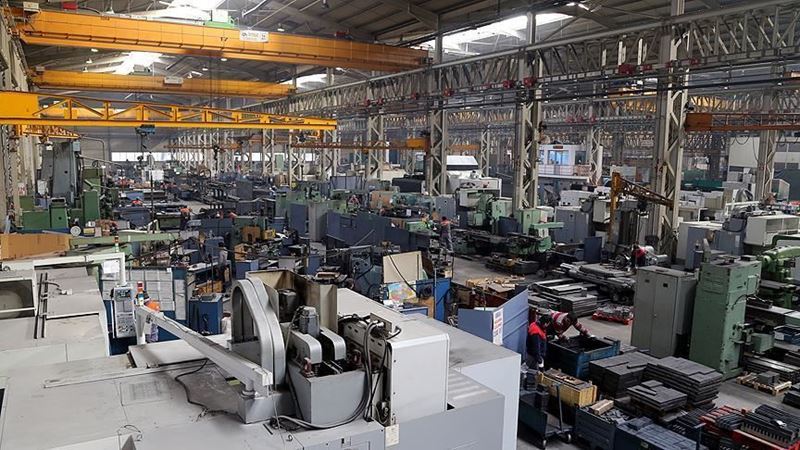
During this period, exports decreased by 10.6% in volume, while a 16.9% increase in the average export price per kilogram drove the rise in value. The annualized consolidated machinery exports reached USD 28.9 billion, marking a 2.6% increase compared to the previous 12 months.
Germany and the U.S. are the largest markets
In the January–February period, the highest export was to Germany, totaling USD 561 million, while exports to the U.S. increased 57.6% to USD 370 million. Italy ranked third, with exports surpassing USD 100 million, up 16.4%. Exports to Russia and Iraq decreased by 32% and 44%, respectively.
By subsectors, the highest export was in “internal combustion engines and components” with USD 439 million. This was followed by “construction and mining machinery” at USD 291 million and “pumps and compressors” at USD 249 million. The sector with the highest percentage growth was “turbines, turbojets, and hydraulic systems”, which increased 40.7%.
Energy shocks are not expected to completely curb machinery demand
Turkish Machinery Exporters’ Associations' Chairman Kutlu Karavelioğlu evaluated the impacts of the U.S. and Israel’s attacks on Iran on energy costs, global inflation, and investment appetite. Karavelioğlu noted that uncertainties in energy and logistics costs directly affect investment plans, and highlighted assessments that the volatility in energy prices could have stagflationary effects on the European economy.
Despite this, he emphasized that demand for energy efficiency, industrial automation, and process modernization continues unabated, and that the EU’s Carbon Border Adjustment Mechanism (CBAM) is accelerating the transition to sustainable production technologies. Karavelioğlu stated that energy shocks are seen not as a factor reducing machinery demand, but as an opportunity to increase demand for new technologies.
Defense industry drives machinery sector demand
Karavelioğlu said that geopolitical tensions are rapidly increasing defense industry investments, noting that European countries’ recent defense imports have created a strong demand channel for the machinery sector. He explained that the machinery, materials, and engineering ecosystems used in defense production generate a multiplier effect in the sector. Increasing European security spending is encouraging machinery manufacturers to shift toward the defense main industry and modernize industrial infrastructure.
Critical period in global competition
Karavelioğlu highlighted that Türkiye's position in the EU Customs Union provides an advantage, as “Made in EU” integration is naturally part of the value chain. He stressed that maintaining production integration with the EU and strengthening R&D and high value-added production capacity are critical for consolidating Türkiye’s position in global competition.
He also pointed out that China’s unilateral trade dominance creates unfair competition, noting that annualized machinery imports in January increased to USD 46.5 billion. He indicated that the imposition of additional customs duties seems inevitable.
Sourced by: Anadolu Agency (AA)






Comments
No comment yet.