


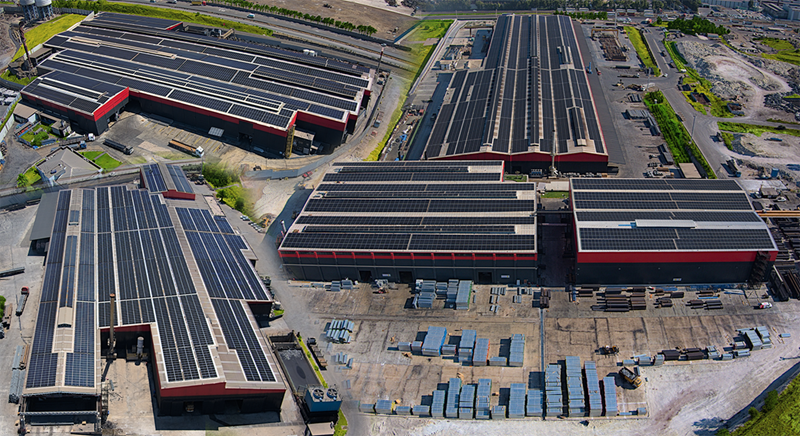
Kocaer Steel, one of Türkiye’s leading steel profile manufacturers, announced its financial results for the second quarter and the first half of the year. The results achieved during a period marked by increasing protectionist measures in global trade, rising geopolitical risks and more pronounced war-related cost pressures clearly demonstrated the company’s ability to rapidly adapt to changing market conditions.
Profitability Strengthened Significantly
Kocaer Steel generated net sales revenue of TRY 11.6 billion in the first half of the year, while adjusted EBITDA reached TRY 1.8 billion and net income amounted to TRY 610 million, supported by its strong performance in the second quarter.
Total sales volume increased by 4.4% year-on-year in the second quarter, while net sales reached TRY 6.2 billion. The company generated adjusted EBITDA of TRY 1 billion and net income of TRY 483 million in the second quarter. Supported by the share of value-added products reaching a record level of 51%, adjusted EBITDA margin reached 16.1% and EBITDA per ton reached USD 125 in the second quarter. This improvement, achieved at a time when global price pressures and cost increases continued, was an important reflection of the company’s efficiency-oriented production approach and value-added product strategy.
In the first half of the year, the share of foreign-currency-denominated sales, including domestic, international and export-registered sales, in total revenues was approximately 95%.
Continued to Maintain a Strong Balance Sheet
Kocaer Steel continued to maintain its strong balance sheet despite global volatility in the second quarter. As of the end of June, the net financial debt/EBITDA ratio stood at 0.70, while its low financial leverage structure continued to be maintained. Thus, financial flexibility was sustained in terms of meeting working capital requirements and implementing investments in new markets.
Flexible Production Capability Stood Out Against Global Pressures
In the first half of the year, the global steel industry remained under the impact of weak demand, supply pressures, increasing protectionist measures, rising costs and geopolitical risks. Global crude steel production continued to decline compared with the same period last year, while Türkiye’s crude steel production increased by 8.1%. Türkiye maintained its position as the world’s seventh-largest steel producer in the first half of 2026, which it had held at the end of 2025.
The pressure created by the war that began in the Middle East at the end of February on energy and freight costs, as well as supply and shipment processes, was compounded by increased tariffs imposed by the United States in recent years and quota regulations in the European market. These developments led to increased cost and price uncertainty in global steel trade.
Thanks to Kocaer Steel’s flexible production infrastructure, broad product portfolio and ability to access different markets, orders from various geographies and sectors were managed in a balanced manner. The ability to rapidly adapt production planning to changing demand conditions also contributed to the increase in sales volume.
Share of Value-Added Products Reached 51% in the Second Quarter and 49% in the First Half of the Year
Kocaer Steel’s growth strategy based on value-added production had a positive impact on its product mix in the first half of the year. The share of value-added products in total sales volume increased to a record level of 51% in the second quarter, while the ratio reached 49% in the first six months of the year.
The share of products targeting sectors requiring engineering capabilities and customized production, such as power transmission lines, solar energy infrastructure, steel structures and mining, increased in sales. The higher margins generated by these products were among the key drivers of the improvement in EBITDA margin and the increase in EBITDA per ton observed in the second quarter.
US Sales Resumed in the Second Quarter
Sales of Kocaer Steel in the US market, where the company had held a strong position prior to the tariffs, had been interrupted following the increase in protectionist measures imposed by the United States on imported steel products from around the world in June last year. As a result of efforts carried out in line with changing market conditions, sales to the US resumed in the second quarter of the year.
It was decided to establish a new US-based company, in which Kocaer Steel will be the controlling shareholder, with the aim of increasing global competitiveness, monitoring customer demands more closely, accelerating quotation and order processes, strengthening direct contact with customers and responding more quickly to developments in the market.
Hakan Kocaer: “We Continued Our Profitable Growth Despite Challenging Conditions”
Hakan Kocaer, Chairman of the Board of Directors of Kocaer Steel, made the following assessment regarding the results:
“The second quarter of the year was a period in which geopolitical risks, trade barriers and cost pressures continued to challenge the global steel industry. Under these conditions, the increase in our sales volume, the rise in our EBITDA margin and the share of value-added products reaching a record level clearly demonstrate that the second quarter was a strong quarter for our company.
The US is one of our strategic markets in which we believe there is long-term growth potential. We consider the resumption of our sales, which had been interrupted following the tariffs, an important development. In order for growth in this market to become sustainable, we need to be closer to our customers and manage commercial processes locally. Therefore, we decided to establish a new US-based structure.
With the new structure, we aim to improve our customer relationships, expand our direct sales channels and respond more quickly to opportunities in the market. We see this step as part of our long-term strategy to strengthen our overseas distribution channels.
In the remainder of the year, we will manage volume growth together with profitability and capital discipline. We will continue to focus on value-added products while further developing our geographical diversification. With the opportunities provided by our strong balance sheet, we will continue to evaluate organic and inorganic growth opportunities.”



Comments
No comment yet.