


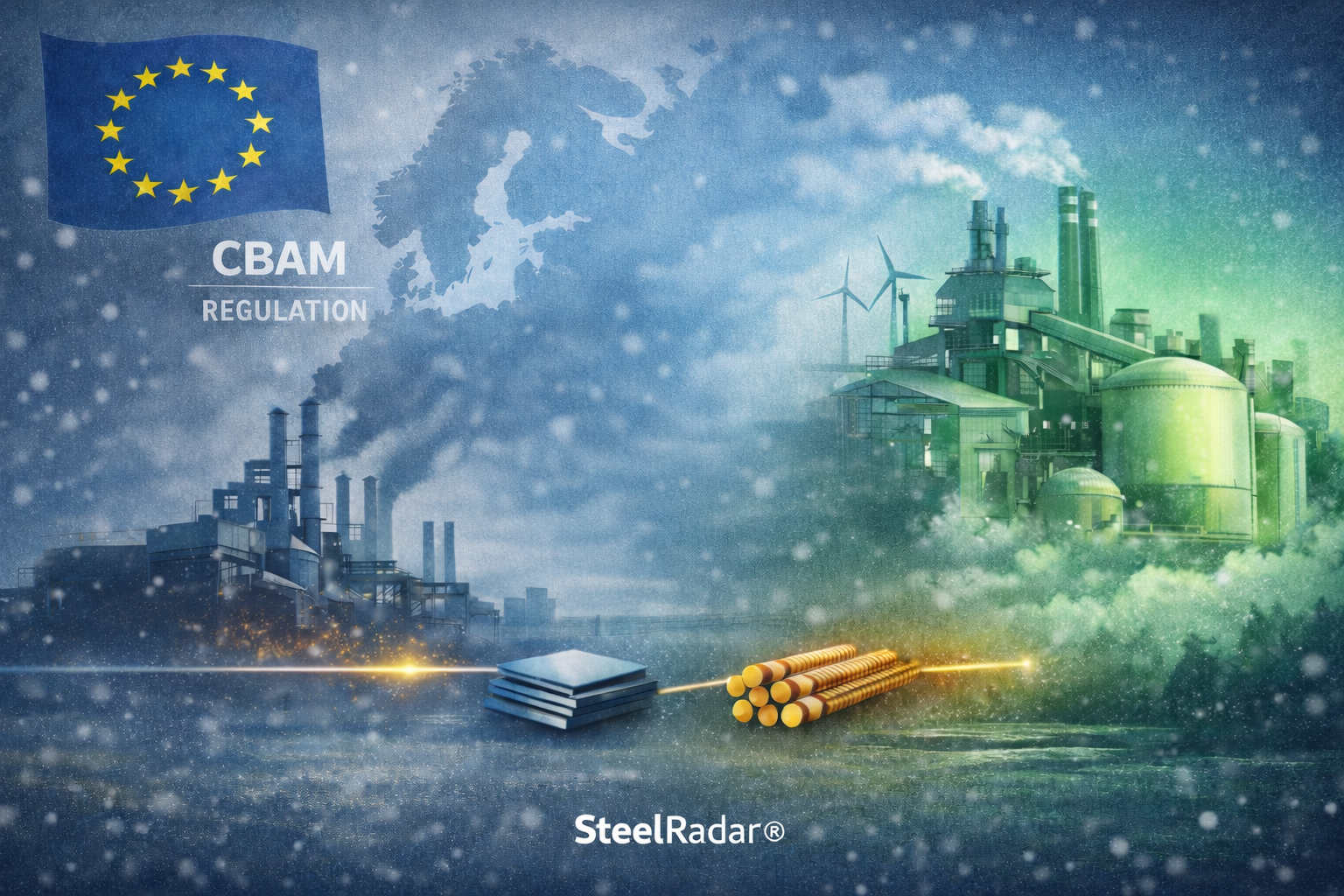
CBAM has moved beyond being a purely regulatory topic, becoming a decisive factor directly influencing pricing strategies, sourcing decisions, and trade flows. In the EU market, traditional price competition is gradually being replaced by verified carbon footprints and low-emission production models.
Within this framework, hydrogen—particularly green hydrogen—has emerged as a key pillar of long-term competitiveness. While carbon-intensive production faces growing cost pressure, low-carbon production models offer a structural advantage under CBAM. However, the complexity of verification procedures and uncertainties surrounding capacity remain significant challenges, prompting some small and medium-sized buyers to step back from the market.
In terms of pricing, flat and long product markets across Central and Western Europe have largely preserved year-end levels, with only marginal, sideways gains. In the Czech Republic, HRC prices have stabilized at €615–620/t, CRC at €710–720/t, and HDG at €715–725/t, with market activity largely confined to year-end deliveries.
In Germany, HRC prices remain flat at €615–620/t ex-works, while CRC €715–720/t and HDG €730–735/t show a slight upward trend. Plate prices are holding around €700–705/t ex-works, and rebar is trading at approximately €605/t CPT. Although demand remains weak, the narrowing of import alternatives due to CBAM and safeguard measures has limited downside price pressure.
In Italy, HRC prices are balanced at €610–620/t ex-works, while CRC is trading at €720–725/t and HDG at €710–725/t. Plate prices are holding near €650/t ex-works. In the long products segment, rebar is trading at €560–600/t ex-works and wire rod at €580–600/t CPT. Traditionally more open to imports, the Italian market is seeing domestic producers increasingly defend internal price levels under CBAM pressure.
Poland presents a more cautious picture on the long products side, with rebar at €560–585/t and wire rod at €615–625/t, as weak demand continues to cap price increases. In contrast, flat products have seen upward momentum for January shipments. Black sheet prices have risen to €680–685/t, CRC to €845–848/t, and HDG to around €935/t, driven by higher scrap costs and disciplined pricing by producers.
Spain stands out as one of the markets showing a clearer recovery in recent weeks. HRC prices have increased to €630–650/t, CRC to €725–740/t, and HDG to €730–740/t, with flat steel prices exceeding German levels—a notable development. This trend is attributed to restricted import availability and relatively more resilient domestic demand.
Overall, the market is ending the year not with a sharp rally, but with a modest, sideways recovery. On the demand side, however, there is no clear sign of a rebound. With the onset of the Christmas period, market activity has largely fallen silent, and many European companies are expected to resume operations from 2 January.
Looking ahead to January, producers are adopting a more confident stance. Full order books and expectations surrounding the full implementation of CBAM are reinforcing the perception that import options will tighten further, providing support to domestic prices. Nevertheless, uncertainty remains over how much of these price increases demand will be able to absorb. As the new year begins, the European steel market enters a critical phase in which January will test the balance between pricing intentions and the reality of demand.




Comments
No comment yet.