


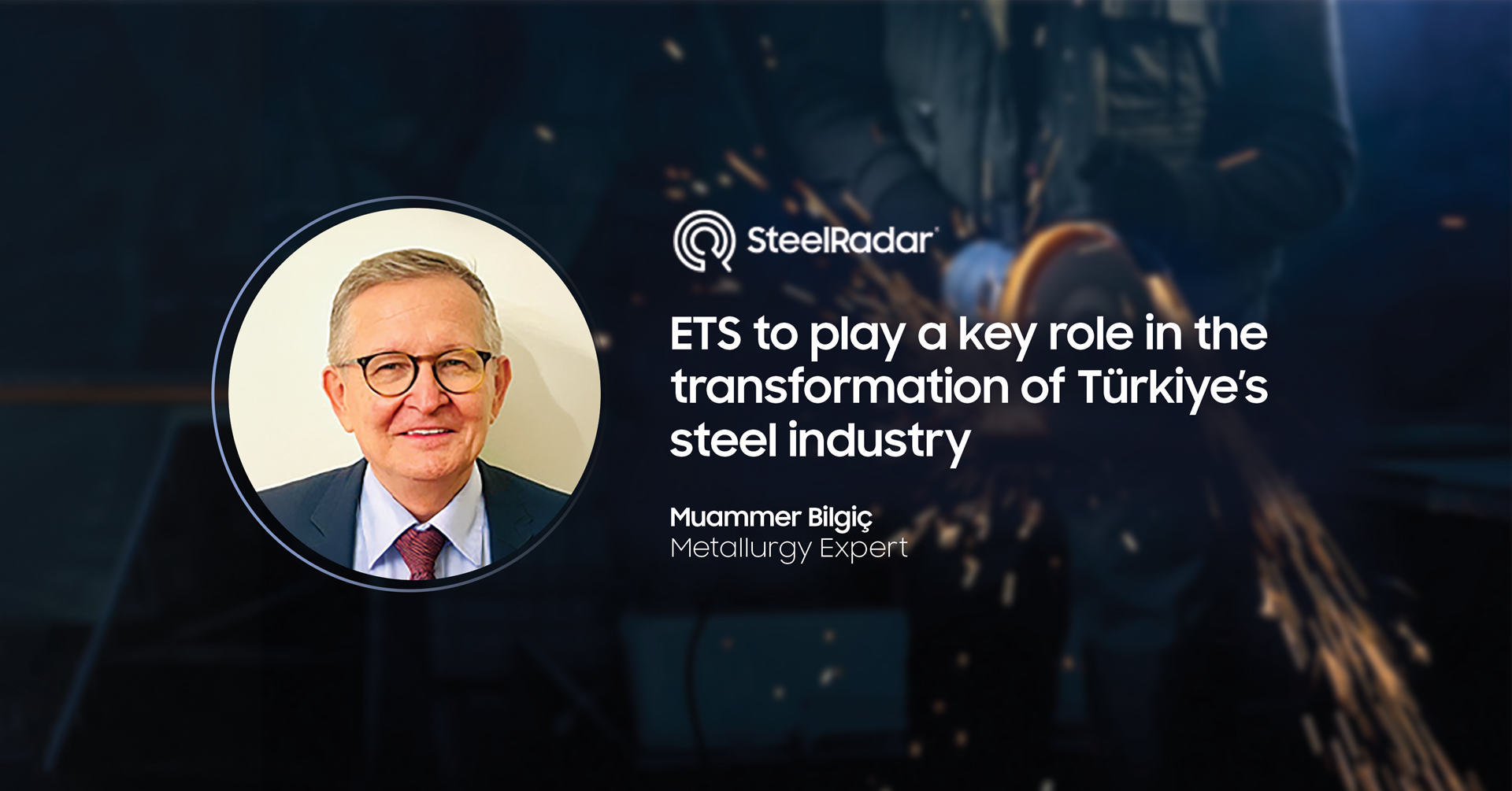
Bilgiç stated that the Emissions Trading System (ETS) is based on the “polluter pays” principle, noting that the system goes beyond voluntary action in the fight against climate change by introducing financial obligations and penalties. He added that ETSs are implemented globally under different models.
Regarding Türkiye’s steel industry, Bilgiç said the rules, methodology and legal framework of the ETS have been developed in detail. However, he noted that the system’s success and its actual impact on the sector will ultimately depend on the emissions thresholds to be established, interim decisions, the pace of implementation and the consistency of enforcement.
Bilgiç said that voluntary approaches have therefore proved insufficient, making mechanisms with strong enforcement capabilities, such as ETSs, the only effective means of compelling action.
Emissions caps will determine producers’ costs
Bilgiç explained that the system is fundamentally structured around an emissions cap determined by the responsible authority. Producers that remain below the cap could potentially convert the difference into a financial gain, while producers exceeding the cap would be encouraged to pursue decarbonization measures to reduce their financial burden.
He said the future financial scale of the ETS will be determined by annual updates to emissions caps, actual emissions declarations verified by accredited institutions, production volumes, free allocation rates, and allowance prices on EPİAŞ and secondary markets.
According to Bilgiç, 50% of revenues generated from penalties, transaction fees and allowance sales will be transferred to the Climate Change Presidency as “special revenue,” provided that these funds are not used for purposes outside the green transition. The remaining portion will be included in the general budget, again subject to the same green-transition requirements.
Risk of speculation in the secondary market
Bilgiç warned that the secondary market could potentially turn into an uncontrolled and speculative trading environment depending on demand. He stressed that focusing solely on avoiding financial obligations through allowance trading, offsets or carbon credits, rather than achieving genuine decarbonization, would undermine the fundamental purpose of the system.
“The real benchmark for green steel is actual emissions”
Bilgiç said the ETS will make it possible to compare the decarbonization performance of steel producers on a more consistent basis. He noted that emissions caps are expected to be relatively flexible initially, while allowance prices are likely to remain low.
This could limit the short-term impact of carbon costs on product prices, he said, adding that the effects of the system will become more significant over time.
Bilgiç warned that keeping the domestic carbon price low would widen the gap between Türkiye’s emissions costs and those under the EU Carbon Border Adjustment Mechanism (CBAM), potentially resulting in this financial value flowing directly to the EU budget.
He argued that claims such as “we produce green steel” that are not supported by updated data, as well as claims that Türkiye has an advantage because it uses the EAF route while overlooking the fact that actual Scope 1 emissions can be twice the EU benchmark levels, should be replaced by concrete figures.
According to Bilgiç, actual emissions are the true measure of “green” steel, and these emissions now have a direct financial cost.
Solar investments do not reduce Scope 1 emissions
Bilgiç noted that both the ETS and CBAM primarily focus on Scope 1, or process emissions, while decarbonization efforts in Türkiye’s steel industry have largely focused on investments in solar power plants (SPPs).
He said investments in renewable electricity are valuable, but primarily reduce Scope 2 emissions. Meanwhile, Scope 1 emissions, which he said have received insufficient attention, are at the core of both ETS and CBAM requirements.
Different emissions caps may be considered for BF/BOF and EAF routes
Bilgiç said that although it is not explicitly stated in the regulation, it is highly likely that separate emissions caps will be established for the blast furnace/basic oxygen furnace (BF/BOF) and EAF production routes.
He argued that such an approach would not necessarily provide EAF producers with a specific advantage under either CBAM or the ETS.
Each producer, he explained, would compete within its own production technology group. He added that if high-emission BF/BOF producers do not compete directly with EAF producers, a serious question remains over how incentives for decarbonization would be maintained.
According to Bilgiç, such an approach could also effectively undermine the “polluter pays” principle, making this an important issue for further debate.
Emissions caps and free allocation levels are critical
Bilgiç said the key issue under the ETS is not so much the transition timetable as how stringent the emissions caps will be and how much free allocation will be provided.
He warned that producer lobbying and domestic policy mechanisms could weaken the process if arguments based on “special circumstances” are used to justify exemptions or more flexible conditions.



Comments
No comment yet.