


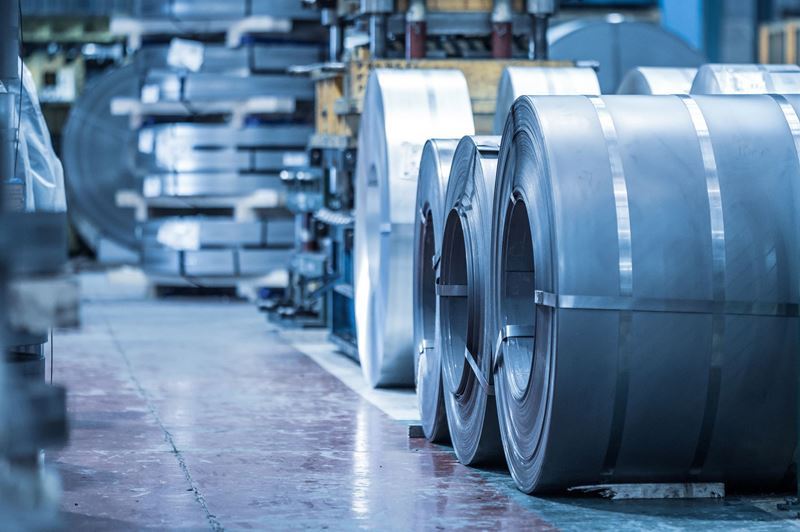
The Turkish iron and steel sector has pointed out that the current approach undermines competitiveness and called for a re-evaluation of default values based on countries' production methods.
Yalçın Ertan, President of the Aegean Iron and Non-Ferrous Metals Exporters' Association, emphasized that CBAM, implemented by the European Union, stands out as one of the most important policy tools of the new era where global trade is reshaped based on carbon.
“For our steel sector, which has a strong integration into the European market due to its export-oriented structure, CBAM has become not only an environmental regulation but also a strategic element directly affecting competitive conditions. The main objective of CBAM can be summarized as preventing carbon leakage and encouraging a more sustainable production structure on a global scale by preventing production from shifting to countries with lower environmental standards. In this respect, the mechanism offers a framework that directly affects producers exporting to the European Union market and the companies importing these products. Therefore, we can say it is critical that the methods and calculation approaches used in practice accurately reflect the production structures of different countries.”
Calculations should be based on real data obtained from producers and verified in accordance with CBAM methodology
President Ertan underlined that the Turkish steel sector holds a distinct position in the world in terms of its production structure and continued as follows:
“Approximately 70% of the production in our sector is carried out using the electric arc furnace (EAF) method, largely based on scrap. This is a significant advantage that highlights Türkiye among countries with lower carbon-intensive production. However, how this advantage is reflected within the scope of CBAM is a separate issue because the carbon emissions embedded in the product directly affect the financial liability. Therefore, how emissions are calculated and how values are verified becomes critical. In cases where this data cannot be fully and properly provided or is not verified by accredited bodies, default emission values come into play. Consequently, how these values are determined, their representativeness, and the extent to which they reflect the actual production structure play an extremely decisive role for exporters.”
Naming accredited organizations is crucial and urgent for overcoming uncertainty for exporters and ensuring the continuity of exports
“As is known, the essential point is that emission calculations are based on real data obtained from production facilities, verified according to CBAM methodology, and confirmed by accredited organizations. Although accreditation is stated as mandatory by the EU within the mechanism, which organizations will be accredited and authorized for verification has still not been determined. This uncertainty regarding the authorization and international recognition of verifiers could make it difficult for our companies to access verification services on time, potentially creating additional costs and operational disruptions in practice.”
It is not possible to accept this approach that does not align with production realities
Yalçın Ertan stated, “On the other hand, we see that despite Türkiye’s EAF-weighted production structure, the default emission values do not sufficiently reflect this structure, and an approach based on higher-emission production methods is being adopted. Türkiye is being represented with a carbon intensity above its actual emission performance. Specifically for some product groups, the values determined for Türkiye being higher than even regions like China—where 90% of production is carried out via the high-emission BOF method—clearly shows that the current approach contradicts production realities. It is not possible for us to accept this approach, which does not align with production realities and creates a serious competitive disadvantage for our sector.”
We expect support from our Ministries for export growth
President Ertan concluded, “We see assessments indicating that the current approach does not fully reflect production realities. Taking Türkiye’s EAF-weighted production structure into account and evaluating default values accordingly is of great importance to ensure our exporters are not negatively affected by price competition. Furthermore, the uncertainty regarding the authorization and international recognition of verifiers could make it difficult for our companies to access verification services on time, leading to additional costs and operational disruptions. Therefore, during this process, we expect support from our Ministries for relevant institutions and organizations to present a common approach and for the necessary initiatives to be brought to the agenda more strongly both in international platforms and before the public.”



Comments
No comment yet.