


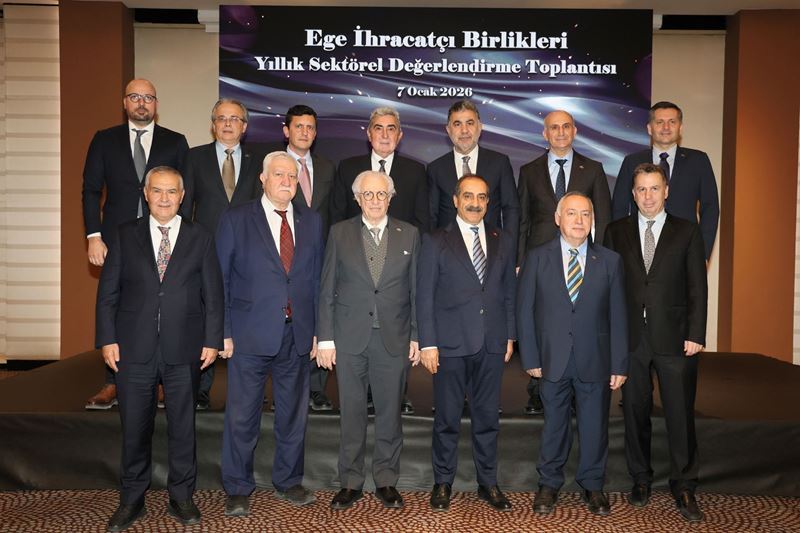
While export figures in 2025 remained at last year’s levels, the Aegean Exporters’ Associations (EIB) emphasized that on the ground conditions have become significantly more challenging. During the Sectoral Evaluation Meeting, the EIB addressed the cost pressures faced by exporters, erosion of profitability, and difficulties in accessing finance.
Jak Eskinazi, Coordinating Chairman of the Aegean Exporters’ Associations, stated that 2025 has been characterized by a global economic environment in which “moderate but fragile growth” has coincided with elevated geopolitical and financial risks.
“There was neither a sharp recession nor a strong rebound in economic growth. While growth rates remained below historical averages, we observed a gradual decline in inflation across most major economies; however, this issue has not yet been fully resolved. The gradual decline in interest rates has provided partial support, particularly for private demand and investments that were suppressed in 2024, yet borrowing costs remain higher than pre-pandemic levels. Rising protectionism and trade barriers are weighing on global trade volumes, and trade policy uncertainty is expected to remain high in 2025 and beyond.”
Exporters in labor-intensive sectors have relocated their production to countries such as Egypt
Pointing out that growth was observed in sectors exporting to the euro area, while USD-denominated exporting sectors faced greater challenges, Eskinazi continued his remarks as follows:
“2025 was a year in which corporate profitability declined for our exporters. Due to rising production costs and the increasing cost of access to finance, we observed that many of our companies continued to borrow abroad throughout 2025. This situation creates significant financial risk and vulnerability in the event of potential currency shocks.In 2025, exporters operating in labor-intensive sectors, particularly textiles and ready-to-wear, continued to relocate their production to countries such as Egypt, where energy and labor costs are relatively lower. The ready to wear and textile sectors experienced significant employment losses in 2025.”
If dependence on imports increases, this means a transfer of value added abroad in the long term
Chairman Eskinazi pointed out that Türkiye’s exports remain low in value added due to the high dependence on imported inputs, which in turn fuels the foreign trade deficit.
“Especially in the manufacturing industry, 60–70% of intermediate goods used in export production are imported. This structural problem erodes foreign exchange reserves and increases economic vulnerability. This picture reveals two fundamental realities at the same time: first, that the production volume and diversity of the main industries in Türkiye have increased; and second, that the domestic supply chain supporting this production has not strengthened at the same pace. If the main industry grows while dependence on imports in the supplier industries increases, this ultimately means a transfer of value added abroad in the long term.”
At what cost, with what level of profitability, and how sustainably has this export performance been achieved?
Emphasizing that on the ground production and import data clearly reveal the tension between targets and actual implementation, Jak Eskinazi made the following assessments:
“This picture means that technological renewal and productivity investments in industry and agriculture are being further postponed. Each year without investment increases the risk of a permanent loss of competitiveness. However, I would like to underline the following: total export figures alone are not sufficient to explain the reality on the ground. The key question that must be asked today is this: At what cost, with what level of profitability, and how sustainably has this export performance been achieved?For many sectors, 2025 was not a year of growth, but a year of survival, resilience, and adaptation.”
Without the parity effect, EIB exports would likely have been lower than in 2024
Chairman Eskinazi announced that the Aegean Exporters’ Associations (EIB) recorded exports of USD 18.505 billion in 2025.
“Our sectors that recorded growth include Grains, Pulses and Oilseeds; Iron and Non-Ferrous Metals; Aquaculture and Animal Products; Tobacco; and Mining. Despite cost pressures, some sectors continued production, while others experienced a deliberate contraction in order to preserve profitability. On an annual basis, the average parity increase was 6%. Considering that approximately 45% of our exports are to the euro area, about 2.7% of the increase in our 2025 exports compared to 2024 stemmed from the parity effect.Although EIB’s total exports in 2025 increased by 1% compared to 2024, when adjusted for the parity effect, our exports in fact declined by 1.7% in 2025 compared to the previous year. Had it not been for the parity effect, EIB exports would likely have been lower than in 2024.
We Must Not Allow This Crisis to Become Permanent
Chairman Eskinazi stated that the concordat figures for the 2022–2025 period clearly reveal the pace of deterioration in the real sector, saying:“In 2022, the number of concordat applications was approximately 1,587, while it stood at 1,516 in 2023. In 2024, this figure rose sharply to 3,497, representing an increase of nearly 130% in just one year. In 2025, even before the year was completed, 4,424 cases were filed in the first nine months alone, surpassing the total for all of 2024.The 2025 data indicate that unless current policy and financing conditions change, we are moving toward a permanent rather than a temporary crisis. We must not allow this crisis to become permanent.Evaluating the textile sector, textile and raw material exports reached USD 9.4 billion in 2025, while our region recorded exports of USD 452 million.”
2026 Will Continue to Be a Year That Tests Resilience Across Many Sectors
Jak Eskinazi stated that Türkiye’s biggest challenge is the weakening of predictability, noting that where predictability is absent, long-term planning becomes impossible, investments are postponed, and risks cannot be taken.
“As we enter 2026, we believe that an approach which puts production at the center, rewards the long term, protects risk-taking, and strengthens industry is both possible and necessary. Otherwise, 2026 will continue to be a year in which resilience is severely tested for many sectors.We do not expect exporters’ foreign sales revenues to increase above inflation in 2026 due to exchange rate movements. In terms of profitability, reducing production costs remains the only viable option. While we have not yet seen any easing in macroprudential measures, we also do not expect relief in credit channels. We believe that USD-denominated borrowing will continue in 2026 as well.We foresee that the challenges faced by labor-intensive sectors will persist. As the Aegean Exporters’ Associations, we adopt a stance that does not ignore problems but rather voices the realities on the ground. Our exporters have made great sacrifices to date; however, supporting these sacrifices with sustainable policies has now become imperative.”
We Recorded Exports of USD 2.591 Billion Again in 2025
Yalçın Ertan, Vice Chairman of the Aegean Exporters’ Associations Coordination Board and Chairman of the Aegean Ferrous and Non-Ferrous Metals Exporters’ Association, stated:“Due to high energy costs and adverse conditions related to other inputs, we have become unable to compete with Far Eastern steel producers in European markets. Our market share in Europe, which once stood at 45%, has declined to around 31%. Despite our intensive efforts, 2023 was a very difficult and troubled year for us. Our main competitors China, Vietnam, South Korea, Malaysia, and Indonesia have pushed us into a highly challenging competitive environment in both European and other markets.In 2025, however, we had a relatively better year compared to the previous three years. While we exported USD 2.351 billion in 2024, our exports reached USD 2.591 billion in 2025, representing an increase of approximately 10% year-on-year. Across Türkiye as a whole, total exports amounted to USD 29.8 billion, comprising USD 16.5 billion in steel and USD 13.3 billion in iron and non-ferrous metal products.”
Chairman Ertan added:“Türkiye is the world’s 7th largest steel producer and the largest steel producer in Europe, followed by Germany. Our main export markets include Germany, Morocco, Italy, the United Kingdom, Egypt, Bulgaria, France, Spain, Romania, Yemen, Greece, and the Netherlands. In addition, we export extensively to Russia, Ukraine, North Africa, Egypt, Morocco, and South America.However, in terms of tonnage, our 2025 exports have still not reached the steel production volumes of 2021. Our capacity utilization rate, which was around 73-74%,decreased to approximately 51% in 2023 and currently stands at around 62%. The global economic environment is in constant flux, with significant uncertainties. All competing countries are implementing protectionist measures, such as quotas and additional taxes. Once the scope of the Carbon Border Adjustment Mechanism (CBAM) becomes
EMIB’s Exports Increased by 6% to USD 1.3 Billion in 2025
İbrahim Alimoğlu, Chairman of the Aegean Mineral Exporters’ Association (EMİB), stated:“As the mining sector, we achieved USD 6.2 billion in exports in 2025. Thus, our exports, which stood at USD 6 billion in 2024, increased by 3% in 2025. Approximately one-third of our exports, amounting to USD 2 billion, consisted of natural stone exports.In parallel with Türkiye’s overall mining exports, our Association’s exports also increased by 6%, reaching USD 1.38 billion in 2025. As in the previous year, the top three export destinations of our Association were China, the United States, and Spain. Compared to 2024, our exports to China and the United States increased by 12% and 7%, respectively, while exports to Spain declined by 3%.In terms of natural stone exports, the top three countries were the United States, China, and France, respectively. Compared to 2024, our exports to these countries increased by 8%, 29%, and 7%, respectively.”



Comments
No comment yet.