



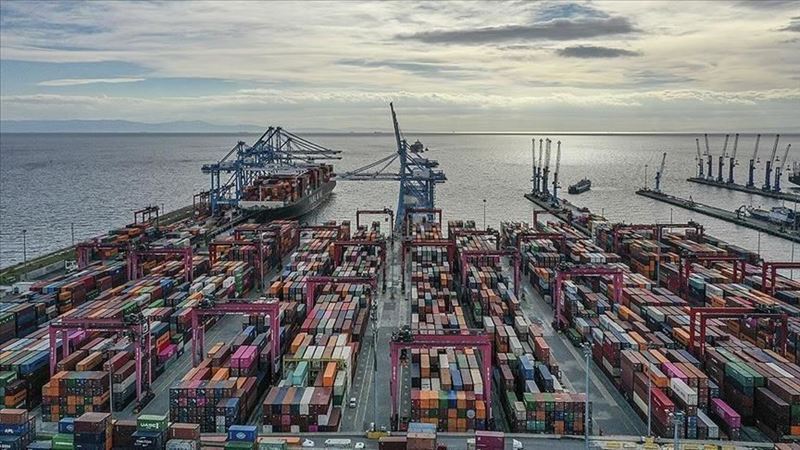
Responding to year end questions from an Anadolu Agency correspondent, Engin stated that transportation in Türkiye is carried out through four main modes road, air, sea and rail and that the country has a geography where all four modes are actively used.
Emphasizing that Türkiye has increased its activity across all four transport modes, Engin underlined that Türkiye is primarily a maritime country with major ports and that its maritime fleet is steadily gaining global importance.
Engin noted that maritime transportation has seen a decrease due to geopolitical developments, while air cargo and rail transport are the modes where Türkiye has recently made major infrastructure investments.
Pointing out that air cargo has come to the forefront, followed by rail transport, Engin stated:
“As is well known, Istanbul Airport has reached a very advanced stage in passenger transportation. With the significant investments made by our flag carrier Turkish Cargo, Türkiye also made progress in air cargo transportation during 2024 and 2025. Air cargo has a smaller capacity compared to maritime transport, but it is a high value transport mode. This value driven mode recorded an increase of around 2.5 to 3 percent in both 2024 and 2025. Türkiye’s share in this growth is expanding in terms of tonnage and destination diversity. From this perspective, it is possible to describe 2025 as a brighter and more positive year for air cargo.”
“Suez is so critical that it could become our sole focus”
Engin stated that 2025 has brought certain challenges, adding that although the demand side experienced a profitable year in 2024 after the pandemic, 2025 has not been as profitable.
He noted that demand has slowed particularly in maritime transport, leading to a decrease in profitability, and said that 2025 has not been a very strong year in this respect.
Explaining that globally 2025 has remained slightly behind 2024, Engin continued:
“At the local level, when we analyze Türkiye’s macroeconomic data together with the needs of our logistics sector, access to finance stands out as a key issue. In 2025, access to finance became more prominent, and SME type family owned logistics service providers faced difficulties. Combined with road transport regulations, technological infrastructure needs, sustainability, green logistics and financing challenges became intertwined and deepened existing issues, particularly for our SME members.”
Engin stated that geopolitical developments such as the ongoing Russia Ukraine war, Israel’s attacks on Gaza and the 12 day conflict between Israel and Iran have negatively affected maritime transportation.
Emphasizing the importance of the Suez Canal, Engin said that the issue remains unresolved and emphasized that it directly affects logistics by increasing costs and risks.
Türkiye seeks stability in Syria for business and logistics
Highlighting the importance of Syria, Engin stated that Israel’s intervention in Syria directly concerns Türkiye.
He emphasized that Türkiye is seeking space for both its business community and logistics sector and therefore seeks stability in Syria, adding:
“As in Iraq, we are looking for channels where we can direct our investments. This is a very pressing issue for Türkiye. These developments directly affect the logistics sector as a whole because Türkiye is making significant investments to modernize, diversify and strengthen its logistics infrastructure. One of these is the Development Road Project. Between 2029 and 2030, the project is expected to extend from Iraq’s Basra Gulf to our borders and possibly pass through Syria via a short rail or road route. All questions related to Syria and Iraq directly affect the efficiency and investment planning of these projects. Therefore, Türkiye is closely monitoring the situation. Just as we can now see the path ahead more clearly in Iraq and plan our investments, we want the same clarity in Syria.”
Addressing the importance of the Zangezur Corridor, Engin emphasized that once operational, the corridor would shift the logistical weight of the Caspian, the Black Sea and especially Georgia toward the Azerbaijan Türkiye axis.
He stated that transportation related to major projects undertaken by Turkish companies in Turkmenistan and other Central Asian countries would become more controllable and faster in terms of cost and process, emphasizing that trade flows could increasingly shift toward Türkiye and Azerbaijan.
Engin also noted that cargo from major production centers such as China and India could be transported to Europe via Türkiye through this corridor, adding that they view it as strategically important, similar to the Development Road Project.
2026 expected to be operationally challenging for the sector
Engin stated that from an operational perspective, the logistics sector is expected to face a challenging year in 2026.
He explained that the factors creating these challenges are likely to continue into 2026 and that rapid solutions are not anticipated.
Pointing out that 2026 may be a tougher year in terms of daily operations, Engin stated:
“Logistics is ultimately a service sector, and its billed return is freight rates. We expect freight rates not to remain very high and to continue at moderate levels. This could have some impact on our exports, as we are seeing a slowing global economy, which in turn slows trade. This suggests that the utilization of broad transport capacities may decrease, which could exert a generally negative pressure on freight rates. In 2026, we expect transport capacity utilization to remain relatively low and freight rates to stay at moderate levels rather than high.”
Reiterating that 2026 will be a more predictable year, Engin emphasized that geopolitical risks are now better understood and can be planned for. He added that there is relative stability in Syria, the process in Iraq is progressing steadily and there is at least a willingness toward resolution in the Russia Ukraine crisis, which could collectively bring greater stability and predictability to 2026.



Comments
No comment yet.