


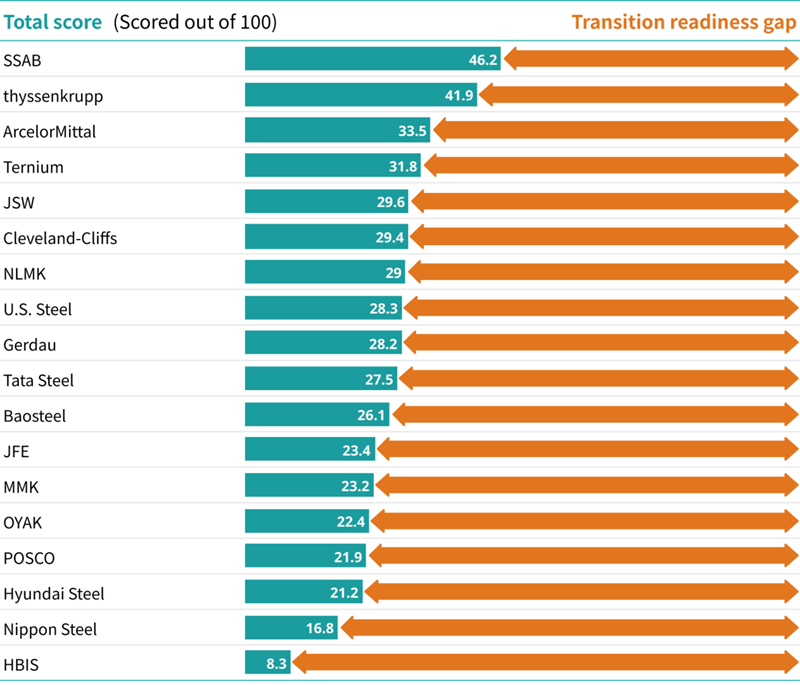
According to the report, while many companies have committed to long-term climate targets, coal dependency remains the norm across the sector, and efforts to scale up green iron production are still at an early stage.
The assessment, published today, covers iron and steel producers operating in 11 countries with a presence in 29 markets. By consolidating previously fragmented and non-transparent company data, the study provides one of the clearest pictures to date of the sector’s climate performance. None of the companies evaluated scored above 50 out of 100, with even the top performers showing significant shortcomings.
Caroline Ashley, Executive Director of SteelWatch, said: “Shamefully, not a single steel producer scored above 50 out of 100. Even the top-ranked companies have major gaps to close before they can claim to be acting responsibly on the climate crisis.”
Accounting for around 10% of global CO₂ emissions, the steel industry remains a critical sector in addressing climate change. Companies assessed in the report include Baosteel, Nippon Steel, POSCO, Tata Steel, ArcelorMittal, thyssenkrupp and Cleveland-Cliffs. All of these companies continue to rely on coal-based blast furnace technology, which accounts for up to 90% of sector emissions.
One of the key findings of the report is the “transition readiness gap,” referring to the discrepancy between the actions required for a credible near-zero emissions transition and those actually taken by companies. While most producers have announced net-zero targets, they lack concrete plans, investments and implementation. Continued investment in coal-based blast furnaces and the limited scaling of green iron production remain major barriers.
The report also highlights that performance in scaling green iron production and renewable energy use remains weak, with average scores below 1 out of 25 in these areas, indicating that the sector is far from the required pace and scale of transformation.
At the company level, SSAB ranked highest with 46.2 points, followed by thyssenkrupp with 41.9 points. These companies stand out for avoiding reinvestment in coal-based assets and for having plans to develop green iron production and phase out blast furnaces. However, the report notes that even these companies need to accelerate implementation.
Meanwhile, Hyundai Steel (21.2 points), Nippon Steel (16.8 points) and HBIS Group (8.3 points) ranked among the weakest performers, driven by high dependence on coal-based production, limited progress in renewable energy and a lack of concrete steps in green iron development.
Despite the overall negative outlook, the report points to some limited progress. Most companies are no longer building new blast furnaces, while some producers have increased direct reduced iron (DRI) capacity, which could be shifted toward near-zero emissions. SSAB was also noted for achieving a notable share of renewable energy use. However, the report stresses that progress must go beyond announcements and be backed by concrete action.
The SteelWatch Corporate Scorecard covers a wide range of companies, including SSAB, thyssenkrupp, ArcelorMittal, Ternium, JSW Steel, Cleveland-Cliffs, NLMK, U.S. Steel, Gerdau, Tata Steel, Baosteel, JFE Steel, MMK, Oyak, POSCO, Hyundai Steel, Nippon Steel and HBIS Group.
The assessment is primarily based on companies’ annual reports for the 2025 fiscal year, covering data from 2024. It notes that investments made during this decade will be critical in reducing coal dependency and scaling green production, and that progress across companies will be closely monitored.



Comments
No comment yet.