


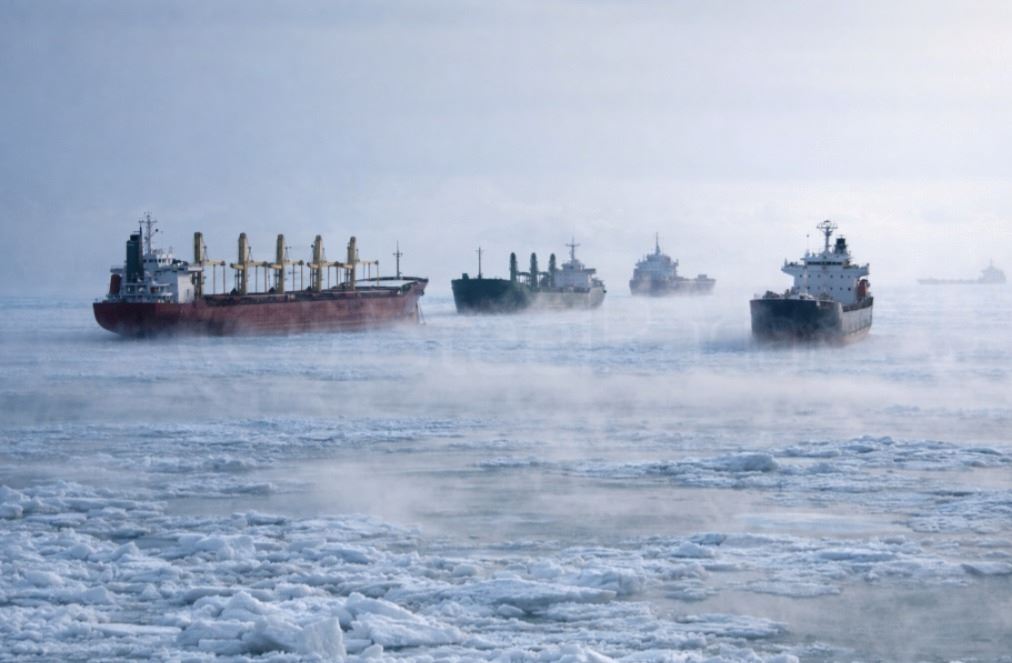
Port authorities have imposed rigorous restrictions on ship movements in ice because the icebreaker fleet is insufficient. Compounding the problem, mandatory underwater inspections of vessel hulls cannot be effectively carried out due to limited infrastructure and low temperatures.
Ice Conditions and Port Regulations
The Ministry of Transport reported that the ice thickness exceeded expectations, with projections reaching 0.3–0.4 meters by early March. On February 16, the captain of the Big Port of Saint Petersburg imposed navigation restrictions: vessels without ice reinforcement could operate only under individual escort when ice was 15–30 cm thick, while Ice1-class vessels required mandatory escort. By February 19, as ice reached 30–50 cm, non-reinforced vessels were fully prohibited, and only Ice1 and Ice2 ships could enter the port under icebreaker guidance. Similar restrictions were applied at the port of Ust-Luga.
The scarcity of icebreakers has exacerbated the situation. A letter from "Russian Steel" to the ministry on February 13 noted that these limits have effectively paralyzed exports of metal products from Northwest ports. Even vessels with ice-class certification require long individual escorting, sometimes lasting 16–24 hours.
Underwater Inspections and Production Risks
The presidential decree from July 2025 still requires full underwater inspections of all incoming vessels from abroad, including video documentation. Since November 2025, port operators are responsible for organizing these inspections. However, inspections in Ust-Luga and the Big Port have been difficult to maintain. Ice around Gogland Island makes inspections physically impossible, and average inspection time in the Baltic between October and January was 11 hours 27 minutes.
Alexey Gordymov, overseeing business continuity at "Rusal," emphasized the critical importance of the Big Port of Saint Petersburg for alumina deliveries needed for uninterrupted aluminum production. He warned of potential production stoppages due to raw material shortages, as icebreaker escort priority is given to other vessel types. Alexander Masko, head of the First Port Company, previously forecasted that these restrictions could halt key export sectors, including ferrous and non-ferrous metals and mineral fertilizers.
Mitigation Measures and Industry Response
The Association of Sea Port Operators (ASOP) has called for increasing the number of icebreakers in the Baltic region and temporarily suspending the underwater inspection requirement for non-hazardous cargoes such as metals, coal, fertilizers, containers, and alumina while ice conditions remain severe. The Russian Association of Mineral Fertilizer Producers has urged protocols allowing vessels without ice-class certification to access Saint Petersburg and Ust-Luga, citing the scarcity of qualified ships and potential production losses due to shipment delays.
Currently, there is a shortage of ice-class vessels ready to operate in the Baltic. The Baltic Sea Port Administration has taken steps to stabilize the situation. The introduction of stricter ice regulations has been postponed to March 1, allowing previously chartered vessels to be serviced and additional icebreakers to be deployed from Murmansk. The Ministry of Transport has relocated the linear icebreaker "Murmansk" (expected February 19) and requested assistance from Rosatom’s nuclear icebreaker for operations in the Gulf of Finland. Regulations are being developed to allow individual assessment of ice navigability by the Russian Maritime Register of Shipping, potentially permitting vessels with lower ice class to continue moving. As of February 16, icebreaker escort was functioning normally, six ships were waiting, and underwater inspections were proceeding without issues.
The Delo Group highlighted that such extreme ice conditions had not been observed in over 15 years, yet its Baltic terminals continue operations normally. The company emphasized coordination among the Big Port of St Petersburg, Ust-Luga, and relevant authorities to ensure vessel reception, dispatch, and icebreaker escort.






Comments
No comment yet.