


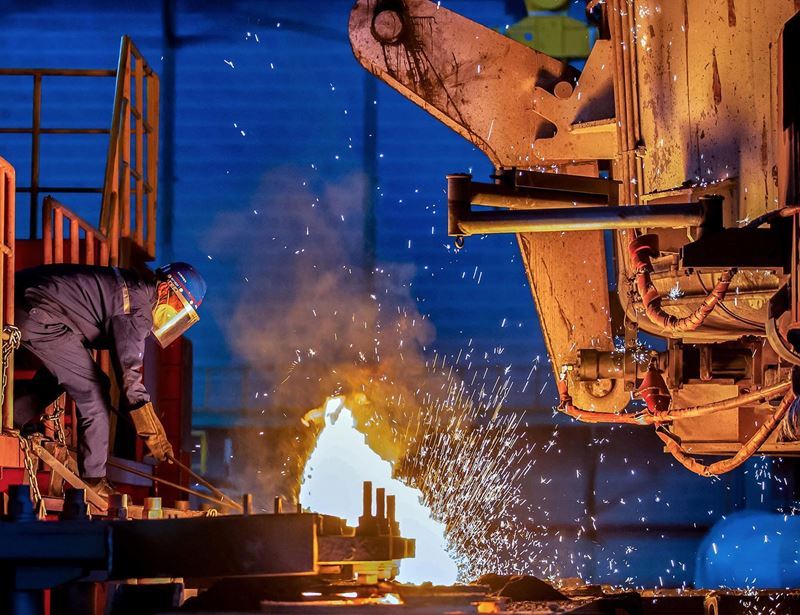
Steel imports into the European Economic Area will be subject to a carbon tax starting 1 January under the EU’s Carbon Border Adjustment Mechanism (CBAM). Introduced as part of the bloc’s decarbonisation agenda, the tax will also apply to cement, electricity, fertilizers and several other products. India, the world’s second-largest crude steel producer after China, sends nearly two-thirds of its steel exports to Europe. Experts note that mills need to reduce carbon emissions to maintain their competitiveness.
Aruna Sharma, former Steel Minister of India, stated that companies are preparing to comply with greener production methods but are simultaneously shifting toward alternative markets. Sandeep Poundrik, a senior official at the Ministry of Steel, emphasized that most steel in the country is still produced through high-emission blast furnaces, and the continued expansion of blast furnace capacity is raising concerns. According to US based Global Energy Monitor, planned new blast furnace capacity in India could generate around 680 million metric tons of CO₂-equivalent emissions.
Indian steelmakers are investing in new capacity to lift production amid strong domestic demand driven by government-backed infrastructure spending. However, uncertainty over CBAM compliance persists. Ravi Sodah, an analyst at Elara Capital, stated that many companies still do not know how to manage CBAM requirements and that a slowdown in India’s exports to the EU is expected in the near term.
One widely discussed solution is the shift to electric arc furnaces (EAF), which generate significantly lower emissions than blast furnaces. Two senior executives at major Indian steel producers, who spoke to Reuters on condition of anonymity, emphasized that there are serious uncertainties about how the tax will be calculated. One executive stated that about 60% of their exports go to Europe and it remains unclear whether the tax will apply at the company level or on a product-specific basis.
Lakshmanan R, Head of Corporate for South and Southeast Asia at CreditSights, emphasized that without emission reduction, the carbon tax will increase costs for India’s steel exports to the EU—particularly for blast furnace products compressing profit margins and reducing market share. Shankhadeep Mukherjee, Principal Analyst at CRU Group, stated that Indian producers are turning to the Middle East to offset potential losses in the EU, seeking entry through fast delivery and flexible payment terms.
Source: Reuters



Comments
No comment yet.