


The iron and steel sector, which is of strategic importance for Türkiye’s economy and industry, is also at the center of climate policies due to its energy and emissions-intensive structure. In this context, various studies are being carried out by public institutions and civil society organizations to better define and steer the sector’s decarbonization process.
Among these efforts is the “Decarbonization of Türkiye’s Steel Sector Project”, launched in mid-2022 by the Istanbul Policy Center (IPC), which operates under Sabancı University. In the first phase of the project, studies titled “Türkiye Status Quo Report” and “Decarbonization Options” were published. During the second and third phases, covering the 2023–2025 period, the report “Decarbonization of Türkiye’s Steel Sector: Policy and Actor Analysis” was completed based on interviews and workshops held with sector stakeholders. The fourth phase of the project focuses on the establishment of the Türkiye Steel Sector Network and the organization of knowledge-sharing activities within this network. While the network was introduced in April 2025, IPC undertakes the role of its secretariat.
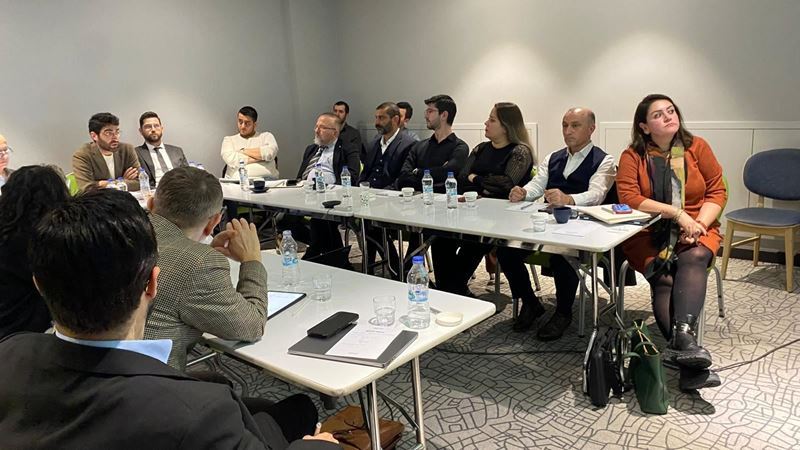
Within this framework, the “Steel Scrap Management Workshop” was organized to examine the role of scrap management in the decarbonization process of the steel sector, discuss challenges encountered in scrap collection and processing, and develop solution proposals. Held in İzmir on 12 February 2026, the workshop addressed the technical, economic, and logistical challenges encountered from the scrap collection stage through to its use as a raw material.
The workshop began with an introductory presentation on the project and the activities of the Steel Sector Network by Ümit Şahin, Climate Change Program Coordinator at Sabancı University IPC. This was followed by a presentation by Dursun Baş, Project Coordinator at IPC Sabancı University, who outlined the purpose and methodology of the workshop.
In his remarks, Baş drew attention to the relationship between scrap and greenhouse gas emissions and shared assessments regarding Türkiye’s steel production structure.
Stating that there are three integrated steel plants in Türkiye producing around 10 million tons of steel, Baş noted that the remaining production is largely carried out by scrap-based electric arc furnace (EAF) facilities. He added that the total capacity of EAF facilities in Türkiye exceeds 50 million tons, and that both the number of facilities and their capacities have increased in recent years.
Baş emphasized that emissions are significantly higher in integrated plants due to coal-based production, noting that approximately 2.2 tons of greenhouse gas emissions are generated per ton of liquid steel produced in coal-based integrated facilities, whereas this figure is around 0.5 tons per ton in EAF facilities. He stated that the three integrated plants producing 10 million tons account for about 65% of total greenhouse gas emissions in Türkiye’s steel sector, while scrap-based facilities account for approximately 35%.
Taking into account greenhouse gas emissions from rolling mills within EAF facilities and increasing steelmaking capacities, Baş indicated that the emissions distribution could approach a 50%–50% split over the next ten years. He also underlined that the quality of scrap melted in steelmaking shops is directly linked to energy consumption (electricity and natural gas) and the volume of greenhouse gas emissions generated in EAF facilities.
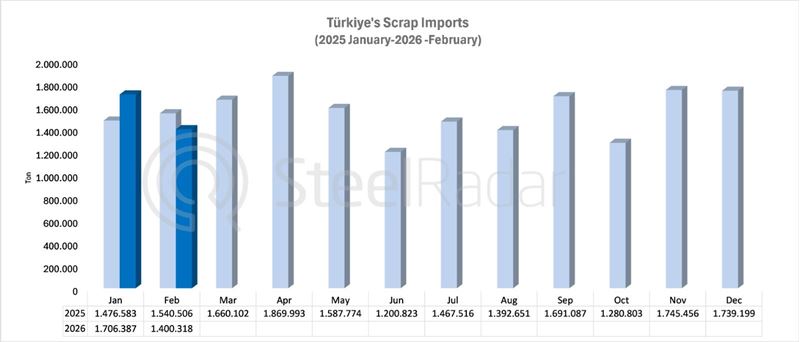
Baş stated that Türkiye sources 20–25 million tons of scrap annually from abroad, while domestic scrap availability stands at around 10–15 million tons. He noted that when access to high-quality scrap is limited, efficiency in EAF facilities declines.
In addition, Baş emphasized that access to high-quality scrap and advanced technology alone are not sufficient for efficient scrap utilization, highlighting that skilled labor and metallurgical process knowledge are also critical.
The workshop also recalled recommendations from the “Decarbonization of Türkiye’s Steel Sector: Policy and Actor Analysis” report, including the establishment of a modernization program to strengthen occupational health and environmental management in the scrap market, as well as the creation of a national scrap inventory, quality classification standard, and traceability system to enhance scrap supply security.
During the workshop, participants discussed the need to support the development of the technical infrastructure and operational capacity of the domestic scrap sector, improve scrap quality, strengthen scrap supply in the domestic market, expand metallurgical process practices that increase scrap efficiency, and conduct feasibility studies on alternative raw material sources.
The event concluded by emphasizing the importance of increasing the number of similar meetings focused on scrap management in the steel sector’s decarbonization process.



Comments
No comment yet.