


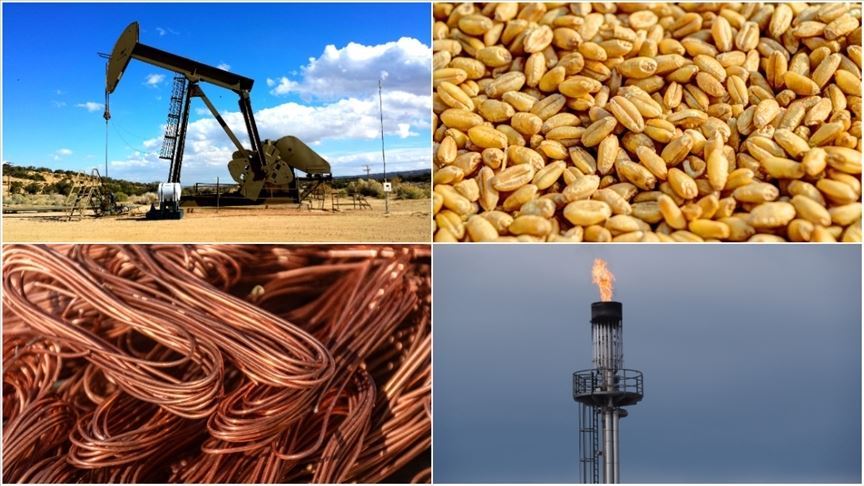
Commodity prices gave back gains after rising to record highs amid profit sales and hopes for progress in negotiations over the Russia-Ukraine war.
Due to the effects of the Russia-Ukraine war, sharp fluctuations were seen in commodity prices last week.
Commodity prices, which saw record levels with the fear that the problems in commodity supply would deepen due to geopolitical risks and that exports might stop, gave their gains back after rising to record levels with the hope of progress in the negotiations within the scope of the Russia-Ukraine war and the effect of profit sales.
While the geopolitical risks that increased with the Russia-Ukraine war played a leading role in asset pricing last week, developments on the subject continued to be important.
Wheat prices traded on the Chicago Mercantile Exchange returned their gains after the historic peak of $13.6350 and closed the week with a loss of 8.4 percent. Expectations that there would be a supply shock in the region, which is one of the world's wheat warehouses due to the Ukraine-Russia war, had brought the wheat prices to a record level.
Concerns that wheat and corn exports would come to a standstill due to war between Ukraine and Russia, the two major wheat exporters in the Black Sea region, were effective in this increase.
Increasing concerns about the supply of seeds and fertilizers also revealed the risk that agricultural activities in the country could not be realized this year. Analysts stated that profit sales were effective in the decrease in wheat prices.
Stating that the demand for wheat decreased with the significant increase in prices, analysts said that the sanctions announced by the USA and Europe had limited effects especially on wheat.
Palladium also made a comeback from the historical summit
Palladium traded on the New York Mercantile Exchange also closed the week with a 6.7 percent decline, with sales coming from record levels after seeing the historical peak at $3,435 an ounce. 40% of global palladium production is provided by Russia. Although palladium prices broke a record due to the war between the two countries, the return of investors to riskier assets also affected palladium prices.
Last week, copper traded on the COMEX market fell 4.6 percent, and platinum traded on the New York Mercantile Exchange fell 4.5 percent. With the increase in copper production in China, decreases were seen in copper prices.
Nickel was on the agenda of the commodity market last week. As of Tuesday, March 8, the LME stopped trading in this asset after nickel prices rose more than 100 percent on the London Metal Exchange (LME) to test the $100,000 levels amid supply woes as well as the strengthening of speculative trading. Thus, LME decided to postpone all physical delivery nickel contracts for the first time in 150 years.
Analysts stated that Russia's nickel exports last year alone exceeded $3 billion, adding that the sanctions announcements led to concerns that the nickel supply would be adversely affected even if the war ended.
While the ounce price of gold continued to rise this week with the ongoing geopolitical risks, it closed the week with a value gain of 0.84 percent.
There were also sharp decreases on the energy side.
After the US banned Russian oil, liquefied natural gas and petrochemical products, the May futures barrel price of Brent oil, which rose to the level of 139.1 dollars in futures, closed the week with a 4.7 percent depreciation due to diplomatic steps and news flow about new suppliers. After rising by 106.8 percent to 192.55 Euros in the previous week, April futures natural gas contracts in Europe increased to 345 Euros at the beginning of the week with the US sanctions on Russia, but declined in the rest of the week and closed the week with a decrease of 31.9 percent.
Natural gas traded on the New York Mercantile Exchange also decreased by 4.9 percent.
German Chancellor Olaf Scholz's statement that it was a conscious decision to continue the activities of commercial enterprises in the field of energy supply with Russia and his defense of energy imports from Russia caused a slackening in natural gas prices.
Expectations that air temperatures will increase and demand will decrease were another factor that affected natural gas prices downwards.
A mixed course was observed in agricultural commodities
A mixed trend was observed in agricultural commodities last week. While cotton traded on the New York Mercantile Exchange gained 0.4 percent and cocoa 0.2 percent, coffee lost 1.4 percent and sugar 0.5 percent.
Traded on the Chicago Mercantile Exchange, corn gained 1.1 percent and soybeans 1.1 percent.
The news from Ukraine and Russia caused fluctuations in agricultural commodities. Forecasts that US exports of soybeans will rise have pushed soybean prices upwards.
Analysts said that the increase in global demand for cocoa used in chocolate production caused prices to rise.
Decline in production and stock forecasts supported cotton prices
Zafer Ergezen, a futures and commodity markets expert, stated that the explanations for an agreement in the war between Ukraine and Russia caused a weekly pullback in prices.
Expressing that the future news flow regarding the Ukraine and Russia war will continue to be effective on wheat prices, Ergezen stated that the decrease in production and stock estimates supports cotton prices.
Emphasizing that sugar finished the week with a decline, Ergezen said that the inability to make any concrete progress in the talks between Ukraine and Russia brought along concerns that economic activities would weaken and demand for sugar would decrease.
Referring to the decline in coffee, Ergezen said, "The increasing concerns about the economies due to the war between Ukraine and Russia are effective in increasing the sales pressure. Especially the expectations that demand will weaken." said.







Comments
No comment yet.