


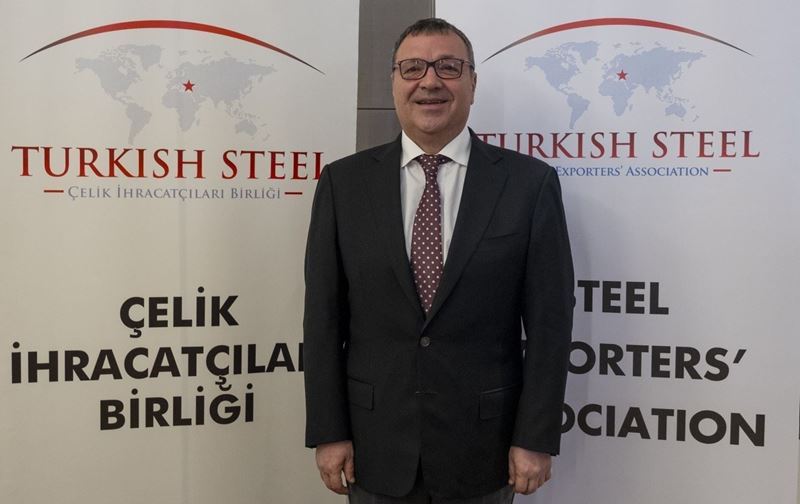
Adnan Aslan stated, “The steel industry is now shifting toward regional growth. We will leverage our fast delivery advantage in nearby markets, while in the medium term, we aim to increase our competitiveness through value-added products.”
Türkiye’s steel sector is entering a new phase in its export strategy amid rising global economic uncertainty, price pressures, and intensifying protectionist trade measures. Having completed 2025 with an increase in tonnage, the sector aims to continue its growth by focusing on nearby markets and expanding exports of value-added products.
In 2025, Türkiye’s steel exports reached 19.432 million tons, with a total export value of USD 16.5 billion. The average export price per ton stood at USD 851. Despite a decline in unit prices, the increase in tonnage demonstrates the sector’s adaptation to global competitive conditions.
Evaluating 2025 performance, Aslan emphasized that the growth was achieved under challenging market conditions, noting that global steel prices remain under significant pressure. He explained that China’s high export volumes and global supply surpluses are driving prices down, and that growth in this environment is only possible by focusing on the right markets and employing a flexible strategy.
Aslan noted that the sector is now turning to geographically closer countries rather than distant and high-cost markets. Rising logistics costs, tariffs, and quotas pose significant barriers in distant markets, whereas nearby markets offer advantages such as faster delivery, flexible production, and strong commercial relationships.
Key target markets include EU countries, non-EU European markets, the Balkans, Eastern Europe, and neighboring countries. Aslan highlighted that sectoral initiatives in markets such as Romania, Bulgaria, the Balkans, Georgia, and Azerbaijan are directly contributing to exports. Deepening presence in existing markets will be a central strategic focus.
Expectations for Recovery in Europe
Aslan pointed out that one reason for the slowdown in European markets is the uncertainty surrounding the Sınırda Karbon Düzenleme Mekanizması. Consequently, exports began 2026 with a decline, but he expects renewed momentum once the process is clarified. He added that European buyers temporarily delayed purchases, but a recovery originating from Europe is anticipated from March and April onward.
Türkiye’s steel exports to the EU reached 7.9 million tons in 2025, while exports to non-EU European countries amounted to 3.7 million tons. The European market accounted for 60% of total exports.
Transition to Value-Added Products Is Inevitable
The second pillar of the new growth strategy is value-added products. While long products and construction rebar still hold a significant share in exports, Aslan emphasized that this structure is not sustainable. Although construction rebar leads in tonnage, its value addition is limited. In the medium to long term, the share of cold-rolled, galvanized, pre-painted products, fasteners, and stainless steel will increase.
This transformation will move the Turkish steel sector away from direct price competition with low-cost producers like China and India. By focusing on value-added production, both price pressure will be reduced, and a more sustainable export structure will be established.
Regional Growth for Stability
Aslan noted that rising quotas and tariffs are among the biggest challenges facing the steel industry, making steel one of the sectors most affected by trade barriers worldwide. Even when exports increase in one market, new trade measures can quickly appear. Therefore, regional growth and product diversification have become a necessity.
2026 Target: Deepening in Nearby Markets
Looking ahead to 2026, Aslan stated that the sector targets 20 million tons in tonnage and USD 17 billion in export value. By focusing on nearby markets and increasing the share of value-added products, the sector aims for more balanced growth, prioritizing proximity and quality rather than distant markets.
World Steel Summit to Be Held in Istanbul
Aslan also highlighted the upcoming conference organized under the Steel Networking Summits 2026, scheduled to take place in Istanbul from October 25–27, 2026. The event will bring together leading global steel producers, traders, supply chain managers, public authorities, and policymakers.He emphasized Istanbul’s strategic location at the intersection of European, Asian, and Middle Eastern markets, offering participants commercial access, logistics advantages, and regional business opportunities. Over 500 industry professionals from 80 countries and more than 40 speakers are expected to attend. The conference will address global challenges in the steel sector and facilitate bilateral business meetings. Aslan noted that the event aims to become an annual tradition, making Turkey a hub for tracking the pulse of the global steel industry.





Comments
No comment yet.