


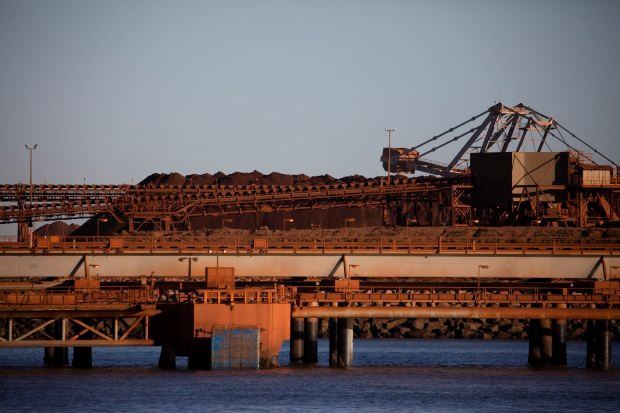
The price of iron ore traded in the futures market fell below $90 a tonne on Wednesday as shrinking steel prices and margins in China put new pressure on the value of Australia's largest export.
The iron ore contract traded in Singapore in December fell 5.2 percent to $86.10 per tonne, currently 64 percent below the record level reached in May.
Spot traded iron ore fell 1.6 percent to $92.30 per ton on Tuesday, according to Fastmarkets MB.
The bulk commodity returned to $135 per tonne last month. However, falling steel demand in China brought steel prices to a six-month low.
"The main reason for the drop in iron ore prices from mid-May was the steel production restrictions imposed by Chinese policymakers, but the difference was that steel prices and margins remained high as demand was still there," said Vivek Dhar, a commodity analyst at Commonwealth Bank mining and energy company.
“However, steel prices in China are currently falling because sentiment in property development areas remains very weak. Declining demand for steel eventually weakened enough to put pressure on prices and margins.” said.
The world's second largest economy has introduced nationwide cuts in steel production to reduce pollution ahead of the 2022 Winter Olympics. It aims to keep production at 2020 levels this year.
Chinese steel prices were supported throughout 2021 by the rapid decline in production. However, the 11% drop in Chinese steel prices last week signaled that further production cuts may be needed to offset the decline in demand.
"This is the first compelling sign that the adjustment in steel production has not gone far enough to cover the drop in demand and could prepare a new round of production cuts," said Justin Smirk, Westpac senior economist.
“We are closely watching the evolving correction in Chinese steel prices. If this continues, it could be the beginning of a second decline in iron ore prices.” said.
Westpac revised its year-end iron ore forecast from $110 per tonne to $100 per tonne and revised its end 2022 forecast from $90 to $80 per tonne.
stocks fixed
China's daily crude steel output fell 4.9 percent to a four-year low in October, down 4.9 percent for the sixth month in a row, the China Iron and Steel Association reported on Tuesday.
However, despite falling production, combined steel inventories at steel mills and in the spot markets tracked by CISA fell just 0.3 percent from the end of September.
"Steel production has fallen but steel inventories have been stable and in some cases increased, meaning apparent demand is still weaker," said Lachlan Shaw, co-head of mining research at UBS.
Market sources told S&P Global Platts that steel inventories are falling much more slowly than steel production, mainly because customer demand, particularly from builders, has outstripped the decline in steel supply.
The move to tighten financing in China's troubled real estate sector stretched into October as property developers' financing value dropped 60 percent in the month, according to data from the China Index Academy. The country's real estate sector accounts for about 30 percent of steel consumption.
The slowing appetite for steel has also led to a steady increase in iron ore inventories, with China's inventories at major ports up 1.5 percent last week to 147 million tons, according to MySteel.
"The supply side doesn't need to do much to put the markets in a weaker supply-demand balance," Mr. Shaw said.
"We're starting to see more iron ore exports from Brazil, which more than makes up for the decline in trade from Australia," he said.





Comments
No comment yet.