


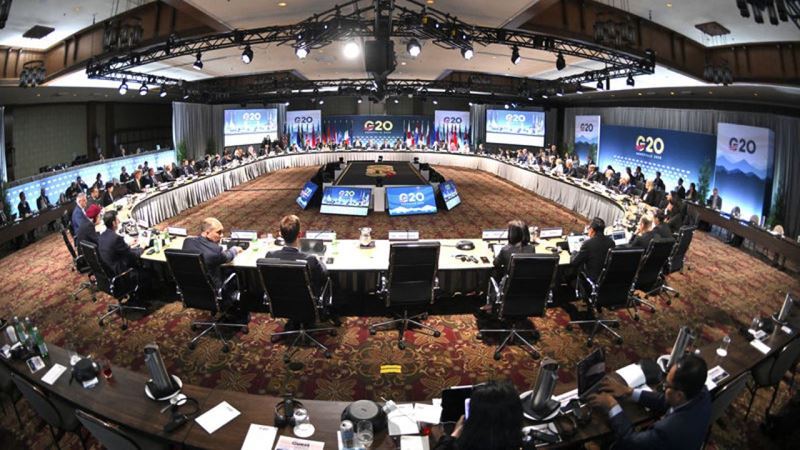
The China-US tensions at the G20 meeting, which brings together the world’s leading economies, led to a dispute over the issuance of a joint communiqué.
US Treasury Secretary Scott Bessent said after the meeting in Asheville, North Carolina, that China had blocked the G20 from issuing a joint communiqué due to disagreements over the country’s massive trade surplus.
Bessent said, “The People’s Republic of China, the country with the world’s largest and most unsustainable current account surplus, was the objecting party.”
The US Treasury Secretary also argued that it was unsustainable for non-market economies to continuously generate low-cost exports.
China did not respond directly to the US
China did not directly respond to Bessent’s remarks but called for a more comprehensive and balanced approach to global imbalances.
Chinese Vice Finance Minister Liao Min said G20 countries should safeguard free trade, support inclusive economic globalisation and create a favourable policy environment for international trade and capital flows.
Beijing also stressed the need to address the root causes of debt problems in developing countries.
Presidency statement issued instead of joint communiqué
The dispute over the joint communiqué was not unprecedented, as G20 members have disagreed on several issues since Russia’s invasion of Ukraine in 2022.
Following the meeting, a statement by the G20 presidency was issued instead of the traditional joint communiqué.
The statement released by the US Treasury Department said countries with excessive and persistent external surpluses should eliminate practices that constrain domestic consumption and make economic growth overly dependent on exports.
It added that such policies have negative effects on global and regional markets and increase economic dependence.
Which provisions did China object to?
According to the US Treasury Department, China objected to:
- The free passage of ships through the Strait of Hormuz,
- The establishment of a task force to examine and reduce trade imbalances,
- The IMF’s authority to monitor global imbalances,
- Certain provisions concerning debt restructuring.
Following these objections, G20 members failed to reach consensus on a joint text.
Russia backs statement in notable development for China
Bessent said 19 G20 members, including Russia, supported the presidency statement.
Russia’s support for the statement was notable. Beijing had previously refused to join G20 statements criticising Russia over the war in Ukraine, making Moscow’s support on this occasion a different development.
Bessent also met with Russian Finance Minister Anton Siluanov on the sidelines of the meeting.
The meeting was seen as one of the rare high-level economic contacts between Russia and the US in recent times.
Trade tensions intensify at G20
The latest dispute at the G20 meeting highlighted widening differences among the world’s largest economies over trade balances, export policies and the global economic order.
China’s large trade surplus and US criticism of its trade practices in particular are expected to remain among the key issues on the global trade agenda in the coming period.






Comments
No comment yet.