


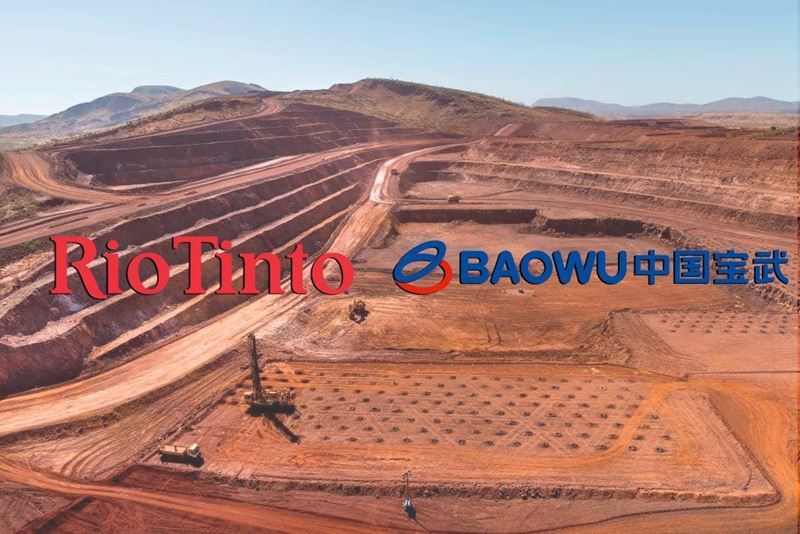
According to a joint announcement, industrial-scale trials conducted at China Baowu’s Baoshan Iron & Steel plant in Zhanjiang, China, successfully utilized Rio Tinto’s Pilbara Blend iron ore. The trials were described as a significant step toward low-carbon steel production using hydrogen-based shaft furnace technology.
As part of the process, direct reduced iron (DRI) was produced in a hydrogen-based shaft furnace using pellets made from Pilbara Blend iron ore, which accounted for approximately one-third of the pellet feed. The resulting DRI was subsequently converted into steel in an industrial-scale basic oxygen furnace and was also tested in a small-scale electric smelting furnace.
The trials demonstrated the potential for medium-grade iron ore from Western Australia’s Pilbara region to be used in hydrogen-based direct reduction processes. The companies noted that this could support the development of a new supply chain for low-carbon steel production when combined with electric smelting furnace technology.
The initiative forms part of a collaboration under a Memorandum of Understanding (MoU) signed by the two companies in 2023, aimed at reducing carbon emissions from steelmaking.
China Baowu stated that the successful trials represent a tangible step forward in the development of low-emission steelmaking technologies, while Rio Tinto highlighted the industrial-scale viability of Pilbara ore in hydrogen-based direct reduction processes as an important milestone.
As part of a partnership spanning more than 50 years, the two companies have been advancing a multi-stage low-carbon steelmaking transition program since 2020.






Comments
No comment yet.