


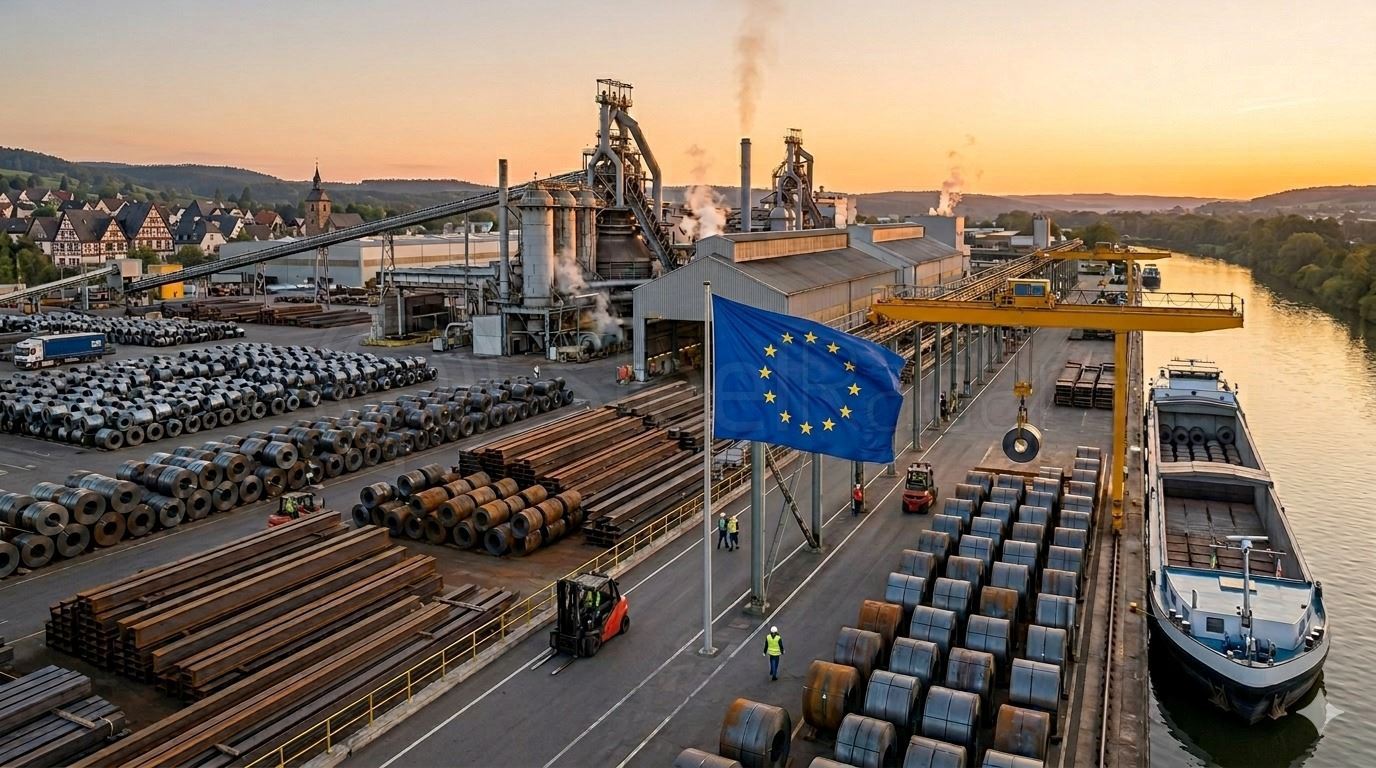
European market participants point out that the new regulations could create additional pressure on supply chains and competitive conditions in the coming period, while the overall outlook remains cautious despite limited improvement in Germany’s steel and metal processing sector.
Steel prices across Europe are generally moving sideways with regional variations. In Germany, rebar is priced at €700-710/t CPT, S235JR plate at €760-770/t EXW, CRC at €810-820/t EXW, and HRC at €680-690/t EXW.
In Italy, HDG and CRC remain stable at €800/t EXW, while HRC is holding at around €670/t EXW. Rebar is trading at €700-710/t EXW. In Spain, HRC prices are moving within the €690-695/t EXW range. European producers noted that high inventory levels and weak demand continue to put pressure on prices, while market activity has also slowed due to the holiday season across Europe.
In Poland, trading activity remains weak due to subdued demand. Wire rod prices stayed flat at €710-735/t CPT, while the rebar price range widened to €670-700/t CPT.
Market participants report that trading remains sluggish due to high inventory levels, weak industrial and automotive demand, and uncertainty surrounding the new import quotas set to take effect on July 1. Nevertheless, producers are attempting to raise third-quarter offers by citing the upcoming quota adjustments.
On the import side, HRC offers from Türkiye were heard at €600/t CIF Italy, while offers from Asia and Algeria were reported at €720-750/t DDP Southern European ports. Market sources stated that no significant price declines are expected under current conditions, but a meaningful upward movement is also unlikely without a strong recovery in demand.
Although companies have long believed that CBAM (Carbon Border Adjustment Mechanism) compliance would primarily require preparing for increasingly complex emissions reporting processes, recent developments suggest that the main challenge lies not in reporting itself, but in effectively managing customs, supply chain, and product classification risks. As reporting becomes increasingly standardized and automated, operational risk analysis and trade strategy management are emerging as the key priorities for companies.
In the Balkans, Serbian President Aleksandar Vučić and HBIS Group Chairman Liu Jian discussed low-carbon steel production, green energy projects, and the modernization of the Smederevo plant during a meeting in Beijing. HBIS has also reportedly applied for a grid connection for a 63 MW solar power plant in Smederevo. Meanwhile, Serbia’s new steel import quotas and carbon regulations are affecting HBIS operations, while the country’s crude steel production fell by 23.7% year on year to 388,200 mt in the first four months of the year.
Overall, while European steel prices are expected to remain stable in the short term, weak demand, high inventories, CBAM-related cost pressures, and upcoming import quota changes continue to shape market dynamics. Although producers are trying to support prices, expectations for a strong recovery remain limited without a sustained improvement in underlying demand. As a result, the sector is expected to remain focused on both regulatory developments and demand trends in the period ahead.




Comments
No comment yet.