


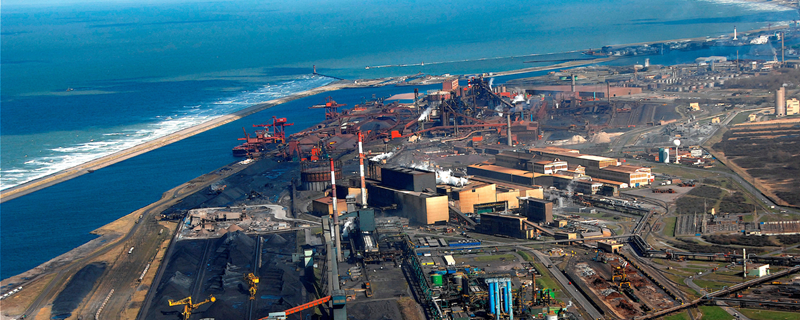
According to the company, the EUR 1.3 billion investment is considered a major milestone in ArcelorMittal’s decarbonisation process for its steel production in France.
On the day the investment decision was announced, ArcelorMittal hosted French President Emmanuel Macron at the Dunkirk facility. The visit was also attended by Roland Lescure, Minister for the Economy, Finance and Industrial and Digital Sovereignty, and Sébastien Martin, Deputy Minister for Industry. President Macron was welcomed by Reiner Blaschek, CEO of ArcelorMittal Europe – Flat Products; Anne van Ysendyck, Head of Government Affairs and Environment; Alain Le Grix de la Salle, President of ArcelorMittal France; and Bruno Ribo, CEO of ArcelorMittal France.
The electric arc furnace, with an annual capacity of 2 million tonnes, is scheduled to be commissioned in 2029. The facility will use a mix of scrap, HBI/DRI, and hot metal, enabling production with approximately three times lower CO₂ emissions compared to blast furnaces. CO₂ emissions from the electric arc furnace are expected to be around 0.6 tonnes per tonne of steel. The investment will be supported by the Energy Efficiency Certificates (CEE) mechanism, which encourages energy savings and emission reductions, with this support expected to cover approximately 50% of the total investment cost.
The company emphasised that recent policy developments at the European Union level played a decisive role in the investment decision. Proposals by the European Commission to limit unfair imports through the Tariff Rate Quota mechanism and to reform the Carbon Border Adjustment Mechanism were said to create a more predictable environment for the European steel industry. ArcelorMittal noted that the full and effective implementation of these measures is critical to restoring fair competition in the European steel market.
Another key factor highlighted was the long-term electricity supply agreement signed with EDF. Securing a low-carbon and competitively priced electricity supply was described as a fundamental step in ArcelorMittal France’s energy strategy. The company stated that the combination of these three developments provided the confidence needed to approve the Dunkirk investment.
ArcelorMittal CEO Aditya Mittal said the EUR 1.3 billion investment in Dunkirk clearly demonstrates the group’s long-term commitment to France. He thanked President Macron and the French government for recognising the challenges facing the European steel sector at an early stage, adding that the changes in market protection mechanisms would benefit not only Dunkirk but the entire European steel industry.
ArcelorMittal Europe CEO Geert van Poelvoorde said the decision to build an electric arc furnace in Dunkirk was made because the necessary conditions for the project’s success are now in place. He noted that the new tariff quota arrangements and the Carbon Border Adjustment Mechanism are creating a fairer competitive environment for European producers, and that support from the government and public authorities in France has been vital in this process.
Reiner Blaschek, CEO of ArcelorMittal Europe Flat Products, also described the Dunkirk investment as a major milestone for the company, stressing that the effective implementation of the announced measures will be critical to the project’s success. He added that ArcelorMittal continues to transform its operations to secure the long-term future of steel production at the heart of the European Union.
Meanwhile, ArcelorMittal is preparing to commission a new electrical steel production unit this quarter at its Mardyck facility near Dunkirk. The plant, built with an investment of approximately EUR 500 million and equipped with the latest technologies, is said to be the group’s largest investment in Europe over the past decade, excluding decarbonisation projects. With this investment, ArcelorMittal aims to expand its product portfolio across Europe to support electrification in the industrial and automotive sectors.



Comments
No comment yet.