


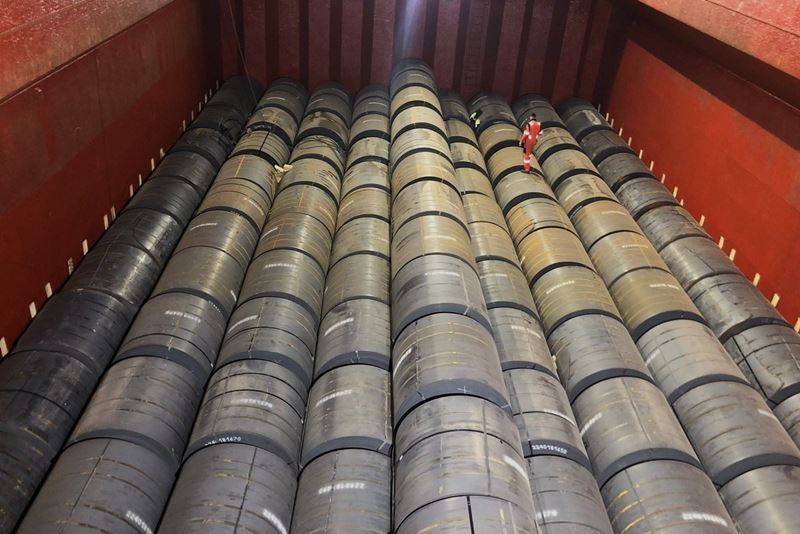
Brussels has officially confirmed that an exemption from green taxes will not enter into force in the short term, meaning British manufacturers will face extensive administrative requirements from January for approximately GBP 7 billion worth of exports to the EU.
The UK government had sought to secure a so-called “carbon linking agreement” with the EU under the Carbon Border Adjustment Mechanism (CBAM), which would exempt UK exporters from carbon-related charges. However, EU commissioners have confirmed that such an exemption will not be possible before Christmas. According to UK Steel, any potential exemption is unlikely to take effect before Easter at the earliest, a delay that would impose a level of paperwork comparable to the customs and standards documentation introduced during Brexit.
Under CBAM, exporters will be required to provide detailed and verifiable records of the carbon emissions generated during their production processes. Plans announced by Brussels on Wednesday indicate that the mechanism will extend beyond raw steel and aluminium to include a wide range of manufactured products made from these metals, such as washing machines and automotive components. Fertilisers, cement and electricity exports will also fall within the scope of CBAM.
While the UK side had expressed hope of reaching an agreement before Christmas, industry representatives acknowledge that such an outcome was never highly likely given political realities. The EU only granted the mandate for negotiations in early December, and the process requires high-level political agreement across all 27 member states, making a short-term solution extremely difficult.
A UK government official said it would be prudent for businesses to prepare on the assumption that EU CBAM rules will apply from January, adding that the Department for Business and Trade will provide guidance and support. Manufacturing trade body Make UK warned that the administrative burden would be “extensive” and would particularly affect small and medium-sized enterprises.
Frank Aaskov, director of energy and climate change policy at UK Steel, said the impact on the sector would be significant. “There will be substantial negative effects. The paperwork will be considerable, and for SMEs this represents a very heavy burden,” he said. Aaskov highlighted that projected CBAM charges of around €13 per tonne for hot-rolled wire—commonly used in construction, fencing and engineering—are critical for the steel sector. With production costs around €650 per tonne, even a €5 difference can determine whether a contract is won or lost.
Although CBAM charges will not be payable until 2027 and could be suspended pending a potential agreement next year, the uncertainty adds another layer of pressure to an industry already facing challenges in trading with the EU. Under EU rules, negotiations will proceed in two stages: first establishing reference conditions, followed by the alignment of emissions trading systems.
Meanwhile, the EU has previously warned that, in response to US steel tariffs imposed under former president Donald Trump, it could raise tariffs on steel imports from third countries such as the UK to 50%—a move described by the struggling British steel sector as an “existential threat”.
EU Climate Commissioner Wopke Hoekstra said on Wednesday that talks with the UK were “progressing well”. Downplaying the significance of the 1 January start date, he argued that the UK’s decarbonisation efforts were on track and that “the cost the UK will actually have to pay will be minimal”. Hoekstra added that progress on aligning different emissions trading systems would need to be gradual.
A UK government spokesperson said the priority remains “to secure a carbon linking agreement as soon as possible that would protect UK industry from paying carbon taxes on GBP 7 billion worth of exports”.
Source: The Guardian

Comments
No comment yet.