


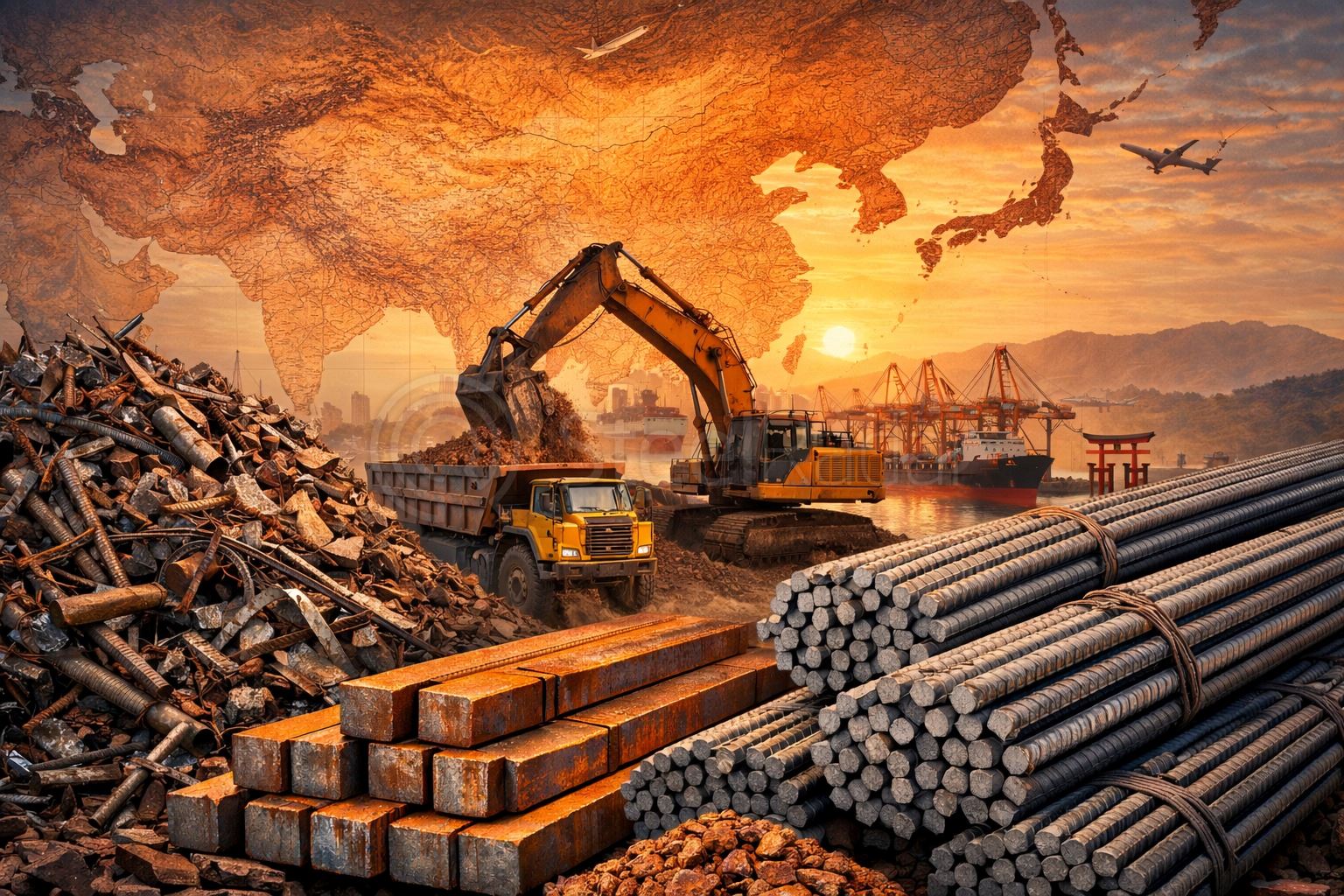
China
China’s trade surplus reached 114.1 billion USD in December and 1.19 trillion USD for full year 2025. Although imports increased by 11.5 percent month on month in December, flat growth on an annual basis indicates that external demand continues to play a more decisive role than domestic demand in supporting economic growth. This highlights China’s sustained dependence on global trade dynamics.
This outlook is consistent with structural weaknesses on the domestic demand side. The prolonged contraction in the real estate sector has permanently reduced new housing starts and related steel demand. At the same time, high debt levels among local governments are limiting infrastructure spending, constraining public sector driven demand growth. On the industrial side, excess capacity and low profitability are leading to postponed private investments. As state incentives mainly operate through supply management and export channels, they are unable to generate strong momentum in domestic demand.
While China continues to support the iron and steel industry, its five year plans and 2035 vision aim to steer the sector toward capacity control, consolidation and green transformation. In January, steel production in China has remained relatively weak due to planned maintenance and overhaul shutdowns at many mills ahead of the Lunar New Year. With only a few weeks remaining until the holiday, market sources view the likelihood of a strong short-term recovery in production and demand as low.
According to the World Steel Association, China’s crude steel production in 2025 decreased by 4.4 percent year on year, while India increased output by 10.4 percent to 164.9 million mt. India’s January production of 14.8 million mt, representing a 10.1 percent annual increase, indicates that production momentum has been preserved at the start of the year. This also shows that India’s weight in global supply balances is gradually rising relative to China.
The Simandou iron ore project in Guinea, with potential annual capacity of 120 million tons despite logistical challenges, could become one of the world’s largest high-grade iron ore deposits. The project stands out as a concrete step in China’s strategy to reduce its heavy dependence on Australia and Brazil, while also creating a significant contribution to global supply.
India
Steel demand in India is growing by around 10 percent, supported by infrastructure investment and the electrification process. At the same time, the government is directing the sector toward higher value-added and lower-carbon production in line with self-sufficiency and green steel targets. Although India is relatively well positioned in iron ore supply, its dependence on imported coking coal is creating cost pressure, limiting pricing flexibility for producers.
Under the National Steel Policy 2017, the Indian government aims to reach annual production capacity of 300 million tons by 2030 and to minimize imports. In line with these strategic objectives, India is protecting its domestic market against imports from countries such as Japan and South Korea, while increasing exports particularly to markets such as Vietnam and Europe.
Trade relations between Japan, South Korea and India are undergoing a significant shift due to India’s measures to protect local production, including the implementation of safeguard duties. Japan’s steel exports to India decreased by 41.1 percent year on year to 950,300 tons in the April–December 2025 period. South Korea has maintained its position as India’s leading steel supplier with 1.71 million metric tons, although its shipments to India also decreased by 18.9 percent. The primary driver behind this overall decline in imports is the Indian government’s effort to shield the local market from low-priced imports. India is preparing to close the 2025–26 fiscal year as a net steel exporter.
Japan
Japan’s crude steel production in December 2025 decreased by 4.8 percent year on year to 6.6 million mt, while full year 2025 output fell by 4 percent to 80.7 million mt. This reflects pressure from weak domestic demand and maintenance-related outages. METI forecasts that crude steel demand in Japan will decrease by 1.6 percent year on year in the first quarter of 2026.
Nippon Steel, one of Japan’s largest producers, is shifting from blast furnaces to electric arc furnaces as part of its carbon reduction strategy. Its new EAF facility is being funded under the Japanese government’s Green Transformation incentive scheme. As Japan is almost entirely dependent on imports for iron ore and coking coal, steel production remains highly sensitive to global raw material prices and logistics conditions. Expected tightening in the scrap market is pushing Japanese producers toward greater use of DRI to secure cleaner metallic inputs, indicating that the sector will need to strike a delicate balance between cost control and emission reduction in the medium term.
South Korea
The decrease in steel production in South Korea has been more limited compared with Japan. In December, crude steel production decreased by 2.4 percent year on year to 5.2 million mt, while full year 2025 output fell by 2.8 percent to 61.9 million mt. Ongoing weakness in the construction sector continues to weigh on production, while export demand for automotive and shipbuilding steel has partially offset this decline.
At the same time, statements by Donald Trump suggesting that tariffs on South Korea origin products could be increased from 15 percent to 25 percent are creating uncertainty around economic recovery expectations for 2026.
Overall assessment
In Asian economies such as Indonesia, Malaysia and Taiwan, infrastructure and industrial investments are supporting steel demand. However, differences in production structures, carbon intensity and trade policies are placing countries in distinct positions within global competition.
As the center of global steel demand shifts toward India, Southeast Asia and the Middle East, carbon regulations are becoming a decisive competitive factor. While China origin steel may remain relatively advantaged under CBAM compared with some Asian producers, it could face cost disadvantages against low carbon intensity producers such as South Korea and Taiwan.
Meanwhile, the continuation and expansion of anti-dumping and countervailing measures against China origin steel across many countries indicate that policy pressure in global trade remains structural. Competition is increasingly shaped by protectionist instruments rather than free market dynamics. This trend is accelerating regionalization and could keep uncertainty and geopolitical risk premiums elevated in 2026.




Comments
No comment yet.