


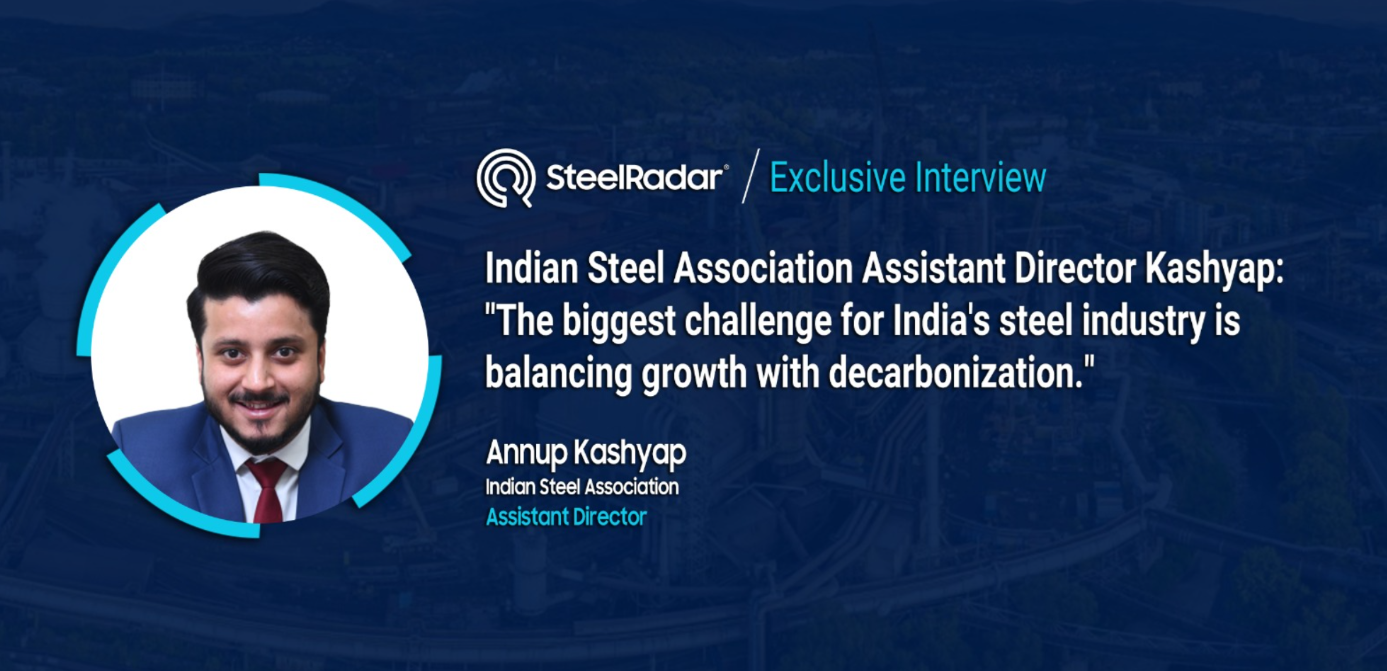
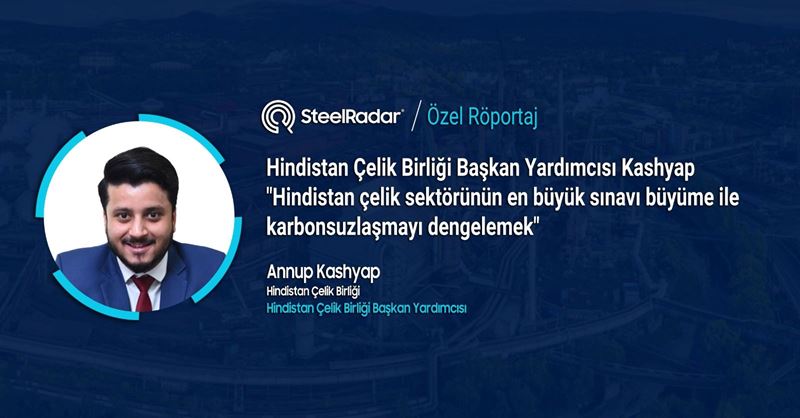
India has set ambitious decarburization targets for its steel industry. In your opinion, what will be the biggest challenges for producers in achieving these goals while maintaining their global competitiveness?
The Indian steel industry is trying to achieve two objectives that often conflict with each other: expanding production while reducing carbon emissions. The real challenge is not the lack of technology, but managing both goals simultaneously.
Today, every ton of steel produced in India generates around 2.55 tons of CO₂ emissions. This is nearly 30% higher than the global average of approximately 1.9 tons. Despite this, the industry is not slowing down to reduce emissions; on the contrary, it is expanding. India's current steelmaking capacity of around 200 million tons is targeted to reach 300 million tons by 2030, meaning that nearly 100 million tons of new capacity must be added over the next four years. However, most of these investments are still planned around coal-based blast furnace-basic oxygen furnace (BF-BOF) technology. Since these facilities typically operate for 30 to 40 years, the investments approved today will determine India's emissions profile well into the 2050s and 2060s.
In addition, India faces a significant challenge in steel scrap utilization. Scrap currently accounts for around 25% of steel production, compared to the global average of roughly 35%, mainly because the country's scrap collection and processing infrastructure is still underdeveloped. At the same time, approximately USD 283 billion will be required to decarbonize existing steel plants, while another USD 251 billion will be needed to ensure that the new capacity planned by 2030 remains low-carbon.
Therefore, the real question is not whether India can produce green steel. It certainly has the capability. The challenge is whether it can do so quickly enough and at a low enough cost to ensure that producers in Mumbai or Rourkela do not have to offer prices that buyers in Rotterdam or Singapore are unwilling to accept.
"Producers that see CBAM only as a reporting exercise will struggle."
How will the European Union's Carbon Border Adjustment Mechanism (CBAM) affect India's steel exports? What approach should Indian steel producers adopt?
Simply put, the Carbon Border Adjustment Mechanism (CBAM) is the European Union's carbon tax at the border. When steel is exported to Europe, the importer must calculate the embedded carbon emissions and pay accordingly. The mechanism itself is straightforward: exported tonnage multiplied by the product's CO₂ emission intensity and the EU carbon price. Just three figures and one calculation. Yet today, this calculation is becoming one of the key factors determining the competitiveness of Indian steel in one of its most important export markets.
The mistake many exporters make lies in how they report emissions. The EU allows companies to use either their own verified emissions data or the default emission values published for specific product categories. For BF-BOF steel, the current default value is approximately 2.16 tons of CO₂ per ton of steel.
Many Indian producers assume that submitting their verified emissions data is always the safer and more compliant option. However, this is not necessarily the case. If a plant's actual emissions are higher than the default value—which is common among older, coal-intensive Indian facilities—reporting actual emissions results in paying more, not less. I have seen cases where this single reporting decision created a difference of tens of crores of rupees annually for one exporter.
My advice to Indian producers consists of three key points. First, before submitting emissions data, calculate the cost using both actual and default emission values, and choose whichever option is genuinely more economical. This is not exploiting a loophole; it is making a sound commercial decision.
Second, invest not only in emissions reporting but also in actual emissions reduction. Default values under CBAM will gradually become stricter, meaning today's advantage will eventually disappear.
Third, prepare your greenhouse gas accounting systems in accordance with internationally recognized standards such as the GHG Protocol and ISO 14064. Once your actual emissions fall below the default values, you will be able to prove your performance and benefit accordingly.
Producers who view CBAM merely as a reporting requirement will struggle. Those who recognize it as a long-term investment signal will be the winners in the European market over the next decade.
"Green hydrogen will become widespread, but costs must decline."
How realistic do you believe large-scale use of green hydrogen in India's steel industry will be over the next decade? What are the main barriers?
I believe it is realistic, but not within the timeframe many people expect. More importantly, India must first solve its broader energy challenge before green hydrogen can transform the steel sector.
The physics are quite clear. Producing one million tons of steel annually through hydrogen-based production requires around 50,000-60,000 tons of green hydrogen each year, supported by approximately 3-4 terawatt-hours of renewable electricity and around one gigawatt of electrolyzer capacity. At that point, you are no longer simply building a steel plant—you are effectively constructing a small power grid dedicated to supplying a single factory.
Today, green hydrogen costs approximately USD 5-6 per kilogram, making it impossible to compete with coal-based ironmaking. Industry estimates suggest that costs must fall to around USD 2.5-3 per kilogram by the mid-2030s before commercial-scale deployment becomes viable. To become fully competitive economically, prices will likely need to decline further to around USD 1-2 per kilogram by the middle of the century.
India does possess significant structural advantages. The National Green Hydrogen Mission, abundant solar and wind resources, and a rapidly expanding steel industry allow new projects to be designed for hydrogen use from the outset instead of requiring expensive retrofits later.
However, major obstacles remain, including high production costs, insufficient renewable electricity supply at the required scale, and the lack of hydrogen transportation and storage infrastructure.
In my view, meaningful commercial-scale hydrogen-based steel production in India will begin during the mid-2030s and continue expanding steadily toward 2050. Until then, the most effective strategy is to maximize lower-cost decarbonization solutions, including improved energy efficiency, gas-based direct reduced iron (DRI) production where natural gas is available, and most importantly, scrap-based electric arc furnace (EAF) production, which can reduce emissions by approximately 70% compared with BF-BOF production without requiring entirely new technology.
"Public policy must bridge the green steel cost gap."
What role should government policies, carbon markets, and financial incentives play in accelerating decarburization across India's heavy industries?
Government policy must accomplish what the market alone cannot do quickly enough: bridge what the industry calls the "green cost gap."
Today, producing low-carbon steel costs roughly USD 210 more per ton than conventional steel. Regardless of how committed buyers may be to climate goals, very few are willing to absorb this additional cost at scale voluntarily. Until technologies mature and costs decline, someone must bridge this gap, and public policy is the only mechanism capable of doing so.
This is precisely the rationale behind India's emerging policy framework. The Perform, Achieve and Trade (PAT) scheme rewards energy efficiency improvements through tradable certificates, while the Carbon Credit Trading Scheme (CCTS) is beginning to introduce carbon pricing signals similar to those of the EU Emissions Trading System. These measures are complemented by the Green Steel Taxonomy, which defines what products can genuinely be classified as green steel.
Without these mechanisms, decarbonization remains largely a voluntary corporate responsibility initiative. With them, it becomes a business strategy where poor decisions carry real financial consequences.
In my opinion, greater emphasis should now be placed on demand-side incentives. Public procurement policies should require the use of green steel in infrastructure projects, while financial support should help close the viability gap for early hydrogen-based DRI and carbon capture, utilization and storage (CCUS) projects. India successfully used this approach to accelerate its solar energy sector. Carbon markets and taxonomy define the destination, while public procurement and financing mechanisms help build the first commercial projects.
Looking ahead over the next five years, which technological or policy developments do you believe will shape the future of sustainable steel production in India the most?
The most important factor over the next five years will not be a breakthrough technology. The decisive issue will be how India chooses to develop the approximately 100 million tons of new steelmaking capacity planned by 2030.
Since blast furnaces typically operate for 30 to 40 years, the investments approved today will effectively determine India's emissions trajectory well beyond 2050. I believe that prioritizing gas- and hydrogen-ready DRI-EAF plants together with scrap-based EAF production, while limiting additional BF-BOF investments, will have a far greater impact over the next five years than any single technological breakthrough.
On the policy side, attention should focus on the gradual tightening of CBAM default emission values and scope, as well as the evolution of India's Carbon Credit Trading Scheme from a regulatory framework into an active carbon market. Both developments will transform low carbon intensity from a compliance cost into a genuine competitive advantage.
From a technology perspective, the single most important indicator to monitor will be the cost of green hydrogen. Every USD 1 per kilogram reduction significantly improves the economic viability of green steel investments in India. In my view, this will be the defining metric of the entire transition.
At the same time, India must address another equally critical but less visible challenge: access to high-grade iron ore. Hydrogen- and gas-based DRI production requires iron ore with an iron content above 64%, yet less than 20% of global iron ore supply meets this specification. As a result, expanding beneficiation and pelletizing capacity will be just as important as investing in electrolyzers.
Over the next five years, the winners will no longer simply be those with the cheapest coal. They will be the companies that invest earliest in clean energy, high-quality iron ore, and low-carbon steelmaking technologies.



Yorumlar
Henüz yorum yapılmadı