


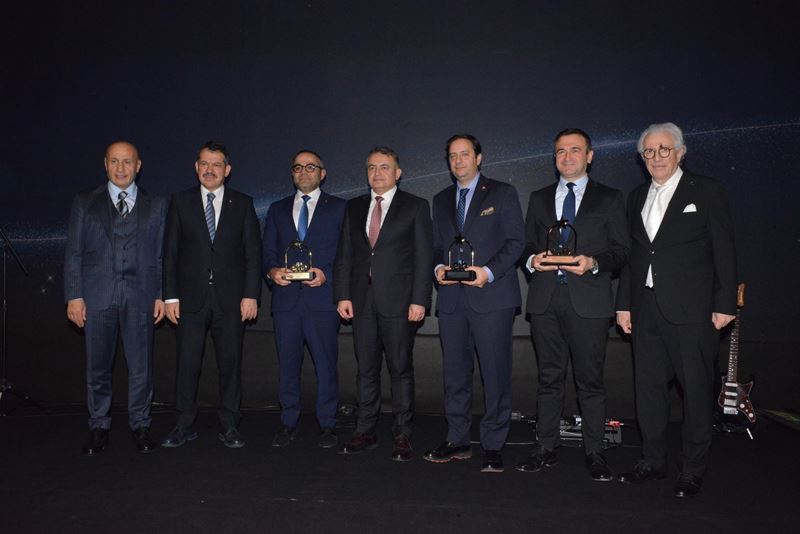
Speaking at the award ceremony, Jak Eskinazi, Chairman of the Aegean Exporters’ Associations (AEA) Coordinating Board, said that 2025 was a year marked by “moderate but fragile growth” in the global economy, accompanied by high geopolitical and financial risks.“In this global environment, the Turkish economy also went through a multi-layered test in 2025. While sectors exporting to the euro area gained a partial advantage, sectors exporting on a dollar basis faced greater challenges. Persistently high financing costs have increased foreign currency borrowing by the private sector, creating serious vulnerabilities in the event of possible exchange rate shocks,” Eskinazi said.
Without the parity effect, AEA exports would have declined as yearly
Noting that employment losses were particularly evident in labor-intensive sectors such as textiles and apparel, Eskinazi continued:
“Some companies have continued to relocate production to countries with cost advantages. As the Aegean Exporters’ Associations, our exports in 2025 amounted to USD 18.5 billion. Although AEA’s total exports increased by 1% compared to 2024, when adjusted for the parity effect, exports actually declined by 1.7% as yearly. Without the parity effect, AEA exports would most likely have been lower than in 2024.”
The Aegean Region failed to capture its share of Türkiye’s export growth in 2025
Referring to export statistics by province released by the Ministry of Trade, Eskinazi said:“In 2025, the Aegean Region generated USD 43.7 billion in export revenues for Türkiye but failed to secure its share of the country’s export growth. While Türkiye’s exports increased by 4.5%, rising from USD 261.7 billion to USD 273.4 billion, the Aegean Region’s export growth rate remained at just 0.6%.İzmir ranked as Türkiye’s third-largest exporting city in 2025 with exports of USD 23.614 billion. Manisa ranked second in the region, earning USD 7.4 billion in export revenues despite a 3.5% decline, while Denizli ranked third, increasing its exports by 6.4% to USD 4.5 billion.”
At what cost, with what profitability, and how sustainably were these exports achieved?
Eskinazi emphasized that more than 8,000 companies contributed to AEA exports in 2025:“Our top 100 companies accounted for 59% of total exports. Today, we will present 51 awards in 17 categories. Award-winning companies, which account for 38% of total exports, generated USD 7 billion in exports. We thank each and every one of our companies. However, total export figures alone are not sufficient to reflect realities on the ground. The key question is this: At what cost, with what profitability, and how sustainably were these exports achieved?”
Without predictability, long-term planning, investment, and risk-taking are not possible
Stating that 2025 was not a year of growth but rather one of survival and resilience for many sectors, Eskinazi said:“The most significant side effect of the disinflation program has been the erosion of profitability and equity in labor-intensive export sectors. As we enter 2026, our biggest problem is declining predictability. Where predictability is weak, long-term planning does not take place, investments are postponed, and risks are not taken. We believe that an approach centered on production, rewarding the long term, and strengthening industry is both possible and now essential.”
Expectations for 2026
Summarizing expectations for 2026, Eskinazi said:“We expect the tight monetary stance to continue, the real value of the Turkish lira to be preserved, the strong-TL policy in the fight against inflation to remain in place, the euro to continue outperforming the dollar in parity movements, no significant easing in credit channels, and ongoing difficulties in labor-intensive sectors.”
Exporters have made major sacrifices
Emphasizing that 2026 will continue to test resilience across many sectors, Eskinazi concluded:“Our exporters have made great sacrifices so far. However, these sacrifices must now be supported by sustainable policies. I hope that 2026 will be a year in which producers are rewarded, investors are encouraged, and action not waiting prevails.”
“2025 was even more difficult than 2024”
Mustafa Gültepe, Chairman of the Turkish Exporters Assembly (TEA), said:“2024 was a difficult year for our exports, and 2025 was even more challenging. Despite all difficulties, we increased exports by 4.5% last year to USD 273.4 billion, reaching the highest annual export value ever. In December, we also achieved our highest-ever monthly export performance with USD 26.4 billion. In 2025, exports increased by USD 11.6 billion in value, USD 7.7 billion of which came from just five companies in the automotive, defense, and jewelry sectors.”
Without parity and five companies, 2025 could have ended in the red
Highlighting a USD 5.4 billion positive contribution from the parity effect, Gültepe said:“Without the parity effect and the contribution of five companies, we could have ended 2025 in negative territory. Net exports have been dragging down growth for four consecutive quarters because the balance between costs and exchange rates has deteriorated. Between January 2022 and January 2026, over four years, the minimum wage increased by 560%, inflation by 367%, the US dollar by 217%, and the euro by 228%. Under current conditions, there is no environment to bring exchange rates to competitive levels, so we must implement alternative support mechanisms to restore competitiveness.”
“We cannot compete globally under these conditions”
Gültepe stressed that labor-intensive sectors urgently need support:“Increasing employment support to TL 6,000, minimum wage support to TL 2,500, improving the effectiveness of FX conversion support, and ensuring exporters’ access to long-term, low-interest financing are essential. We hope that the demands we have submitted to the President will be addressed before the damage grows further. Our core problem is high production costs. For the past 2–3 years, we have not only been exporting products but also trying to export our inflation.”
Referring to global trade wars, Gültepe added:“Countries are erecting tariff barriers and imposing additional taxes. They don’t need to impose extra tariffs on us because even without them, we are still more expensive than our competitors. Under these conditions, we cannot compete globally. Still, we know that opportunities exist even in the toughest times. Last year, more than 6,800 companies exported under the EİB umbrella. I thank all companies that add value to our export ecosystem.”
TL 45 billion in export support planned for 2026
Mehmet Ali Kılıçkaya, Director General for Exports at the Ministry of Trade, said:“In 2025, we provided approximately TL 33 billion in support under the Resource Utilization Support Fund , including TL 25.5 billion for goods exports and TL 7.3 billion for services exports. In 2026, we plan to offer a total of TL 45 billion TL 32.8 billion for goods and TL 12.2 billion for services to our exporters.”
Kılıçkaya added that İzmir exporters have set an exemplary model and that efforts continue to launch an Export Academy Export Expertise Training Program in cooperation with AEA and İzmir University of Economics in 2026.
İzmir ranks 3rd in exports
Kılıçkaya noted:“İzmir ranked third nationwide in exports in 2025 with USD 23.6 billion (2024: USD 23.8 billion). The number of exporters in İzmir approached 15,000, exporting to more than 200 countries and over 7,400 products. Government support for İzmir exporters continues to increase, rising from approximately TL 1.2 billion in 2024 to TL 2 billion in 2025.”
Top three exporting companies among AEA's members
-
PETKİM Petrokimya Holding A.Ş. – First place
-
Kılıç Deniz Ürünleri Üretimi İhracat İthalat ve Ticaret A.Ş. – Second place
-
Pergamon Status Dış Ticaret A.Ş. – Third place






Yorumlar
Henüz yorum yapılmadı